





In this article
- What is the difference between a BOM, a routing and a schedule?
- What belongs in a manufacturing routing?
- Manufacturing routing example: an electrical enclosure
- How to create a manufacturing routing
- 1. Fix the product and revision
- 2. List the operations the product actually needs
- 3. Define the dependencies
- 4. Name the eligible machines and people requirements
- 5. Record times with an explicit basis
- 6. Walk one order through the route
- Can a manufacturing route have parallel steps or alternatives?
- Which routing errors make the schedule unreliable?
- How does the route become a production schedule?
- Frequently asked questions
- Is manufacturing routing the same as production routing?
- Is a routing the same as a BOM?
- Does every product need a different routing?
- Does routing time equal production lead time?
Home » Resources » Manufacturing Routing: Build a Route You Can Schedule
Estimated reading time: 10 minutes
Manufacturing routing defines the operations needed to make a product, the order in which they must happen, the workstations that can perform them and the time each operation needs. It is the product’s manufacturing route, not its calendar. Scheduling uses that route to decide when each operation runs alongside other orders.
A useful route lets a planner answer three questions before releasing work: what must happen next, where can it happen, and how much time will it need? This guide shows how to record those answers, with a small example you can use to check your own routing data.
What is the difference between a BOM, a routing and a schedule?
A bill of materials (BOM) lists the materials and components needed for a product. A routing describes the work needed to turn them into that product. A schedule assigns that work to available time and eligible workstations.
| Record | Question it answers | Enclosure example |
|---|---|---|
| BOM | What do we need? | Sheet metal, terminals, fasteners |
| Routing | How do we make it? | Punch, bend, assemble, test |
| Schedule | When and where do we do it? | Bend this order on Press Brake 2 after the current job |
Changing a component can require a routing change, but the BOM does not itself specify the full operation sequence. Likewise, adding a second eligible machine gives the scheduler another option; it does not mean the product needs a second bending operation.
Microsoft’s routes and operations documentation makes this distinction concrete: a route describes the operation sequence, required resources, setup time and run time for a product or variant.
What belongs in a manufacturing routing?
A route needs enough information to describe the work without making the scheduler guess.
- Product and revision: which item or variant the route applies to, and which approved version to use.
- Operations: distinct stages such as forming, assembly or inspection, with references to the relevant work instructions.
- Sequence and dependencies: what must finish before each operation can start, including any branches that join later.
- Eligible workstations: the machines or work centers that are technically able to do each operation.
- Setup and processing times: how long preparation takes, how processing time depends on quantity, and the units used.
- Other requirements: tools, skills, quality-release conditions or external processing that affect whether the work can proceed.
A work instruction explains how to perform an operation safely and correctly. The routing connects that operation to the rest of production. Link the instruction rather than turning the route into a long procedure that hides the sequence.
A route sheet or job traveler presents routing information for a particular job. The underlying product route can be reused, while the job document adds the order quantity, current revision and completion records.
Manufacturing routing example: an electrical enclosure
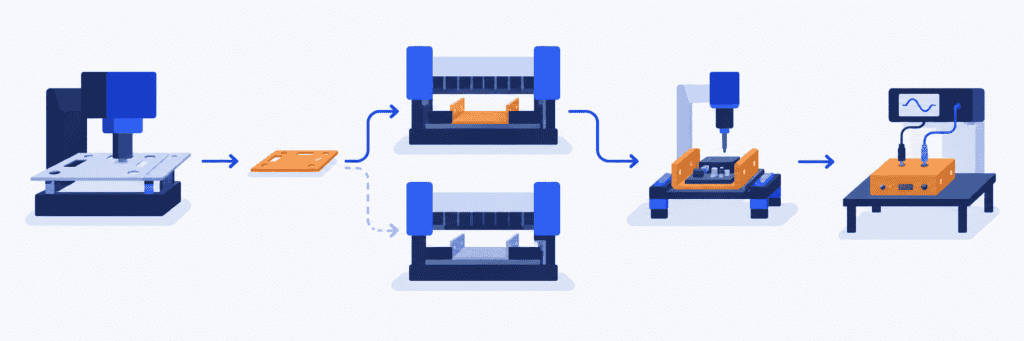
This is an invented example. A manufacturer needs a batch of 12 small electrical enclosures. The sheet blanks and purchased components are ready. Each operation processes the whole batch before the next begins; there is no overlap or waiting allowance in the times below.
| Operation | Must follow | Eligible workstation | Setup per batch | Run time per unit |
|---|---|---|---|---|
| 10: Punch panel | None | Punch 1 | 15 min | 2 min |
| 20: Bend enclosure | 10 | Press Brake 1 or 2 | 20 min | 3 min |
| 30: Fit components | 20 | Assembly Bench A | 5 min | 8 min |
| 40: Electrical test | 30 | Test Bench 1 | 10 min | 4 min |
The route tells the planner that bending cannot begin before punching finishes. Either press brake is approved for this example, so the scheduler can choose between them. Both are assumed to have the same setup and run times here; a real alternative may need different times or tooling.
For 12 units, bending needs 56 minutes: 20 minutes of setup and 36 minutes of processing. That is the work required at the bending step, not a promised finish time. If both brakes are occupied, the batch waits.
The complete batch needs 254 minutes of setup and processing across the four operations. It may take much longer to move through the factory once queues, shifts and other orders are included. A route with accurate operation times is still not a delivery schedule.
How to create a manufacturing routing
Start with one product and a recent order whose actual path you can verify. A short route checked with the floor is more useful than a detailed template copied from a different product.
1. Fix the product and revision
Identify the finished item, variant and drawing revision. Check that the BOM and work instructions describe the same version. A material or design change may affect tooling, operations or processing time even when the item name stays the same.
Record who owns the route and when a replacement version takes effect. Decide how already released orders will be handled; changing the master route should not silently change instructions for work in progress.
2. List the operations the product actually needs
Follow the job from its starting material to the finished item. Include required inspections, outside processing and release steps, not just the operations performed by the largest machines.
Split an operation when it needs a separate workstation, a separate readiness decision or independent progress reporting. Keep minor tasks together when they are performed as one uninterrupted operation at the same station.
3. Define the dependencies
For each operation, name the work that must be complete before it starts. A numbered list is enough for a simple serial route. Parallel branches need explicit dependencies: final assembly may require two subassemblies to be ready.
Separate a technical dependency from a local habit. If testing truly needs completed assembly, keep that constraint. If two independent parts are always made one after the other only because there is one operator, that is a capacity restriction to account for in scheduling.
If partial batches can move forward, record the approved transfer condition. Do not assume the next stage can start after the first unit unless the process and quality requirements allow it.
4. Name the eligible machines and people requirements
Check each proposed workstation against the job’s size, tooling, tolerances and required process. A free machine is not necessarily a suitable machine.
Record approved alternatives before a breakdown makes them urgent. Where machines differ, capture the applicable processing and setup times. Include any tool or operator qualification needed to use the alternative.
For example, a second press brake might fit the enclosure but lack its approved tooling. Listing it as eligible without that condition produces a route the floor cannot follow.
5. Record times with an explicit basis
Separate setup per batch from processing per unit, or state that an operation has a fixed batch duration. Write the units next to the values. An entry of “3” is not enough: three minutes per unit and three minutes per batch create very different workloads.
For a simple operation that processes units one at a time:
Operation time = setup time + quantity × run time per unit
Use a different time model where the process needs one, such as an oven that treats several units together. Record cooling, curing or transport separately when they constrain the next operation; distinguish elapsed waiting time from time that occupies a machine or requires an operator.
Compare the estimate with completed jobs and ask what the recorded time includes. Folding a queue delay into machine processing time makes the next schedule misleading. Setup-time reduction addresses preparation work, which should remain visible rather than disappearing inside a per-unit average.
6. Walk one order through the route
Check the route with someone who performs the work and someone who plans it. Can they identify the next operation, its approved workstation, its prerequisites and its time basis without asking the route’s author?
Use an actual completed order to catch missing stages and unrealistic assumptions. Then check a different quantity or variant. A route that works for one batch size may need different tooling or another process for a larger batch.
Microsoft’s routing setup guide illustrates how product routing data becomes the basis for operation scheduling on a production order. The checks above are system-neutral; they are not configuration instructions for a particular ERP.
Can a manufacturing route have parallel steps or alternatives?
Yes. Parallel operations can proceed independently until a later operation needs their outputs. An alternative route offers another approved way to make the product. An alternative workstation offers another place to perform the same operation.
These are different decisions. Two independent subassemblies may be made in parallel. Two press brakes eligible for bending usually mean a choice of machine, not two required bending steps. A subcontracted finishing route may change the operation sequence and introduce transport and supplier lead time.
MRPeasy’s routing documentation shows dependencies between operations, including parallel and converging chains. Whether those branches can actually run at the same time still depends on available machines, people and tools.
A documented alternative needs technical approval and usable times. The planner should not invent a new manufacturing process simply to make an urgent order fit.
Which routing errors make the schedule unreliable?
A missing operation. The plan omits required inspection or outside processing, so it makes the next operation ready too early. Add the stage and its release condition.
Every machine in a department marked as eligible. The schedule places work on equipment that cannot meet the requirement. Replace the broad list with approved workstations and conditions.
A time with no quantity basis. The same number is used for a batch of 12 and a batch of 120. Separate setup, per-unit processing and fixed batch time.
Outdated revision or tooling. The route still describes the previous design. Review it when the product or manufacturing method changes, and control which version released orders use.
An unnecessary serial dependency. Independent operations are forced to wait for one another. Check whether the restriction is technical or whether it belongs to shared capacity instead.
Fix these problems before trying a more sophisticated scheduling rule. A scheduler cannot make an incorrect route executable by choosing a different start time.
How does the route become a production schedule?
The route supplies the operations, dependencies, eligibility and time requirements. The planner then combines them with order quantities, material readiness, machine and operator calendars, current progress, due dates and priorities.
That next step is production scheduling: placing operations into usable capacity while respecting their sequence. In a job shop, different routes also compete for the same machines. A route that is feasible by itself may still wait behind another order.
SkyPlanner lets the user define a product’s process steps, durations, eligible workstations and dependencies. Arcturus calculates and recalculates the schedule from the configured production data and priorities, and the Gantt view shows the result. The user defines the manufacturing process; the scheduling engine does not invent the product’s route. It integrates with any ERP or MES through its open REST API. To explore how defined routes become a schedule, try SkyPlanner with demo data or book a demo.
Frequently asked questions
Is manufacturing routing the same as production routing?
In this manufacturing context, both terms describe the product’s operation route. Neither means transport-route optimization or network routing.
Is a routing the same as a BOM?
No. The BOM describes the materials and components. The routing describes the operations that transform or assemble them. Keep them aligned when a product changes, but do not use one as a substitute for the other.
Does every product need a different routing?
Not necessarily. Products with the same manufacturing process can share a route, provided the applicable times, workstation requirements and variants are handled correctly. A different design or quantity may require a different approved route.
Does routing time equal production lead time?
No. Setup and processing time describe the work. Production lead time also reflects waiting and other elapsed time between release and completion. You need a schedule and current production conditions to estimate when an order will finish.
Jussi Mäntylä
Production Planning Specialist, SkyPlanner


