





In this article
- What SMED changes and what sequencing changes
- Measure setup time before changing the process
- Apply SMED to shorten each changeover
- 1. Separate internal and external setup tasks
- 2. Move suitable preparation outside the stoppage
- 3. Simplify the remaining internal work
- Reduce avoidable changeovers with a better job sequence
- Keep due dates and usable capacity in the decision
- Configure similarity-based sequencing in SkyPlanner
- Check whether the new plan improves production
- Frequently asked questions
- What is SMED in manufacturing?
- Does SMED mean every changeover takes one minute?
- How do you measure setup or changeover time?
- What is the difference between internal and external setup?
- Can job sequencing replace SMED?
- How does SkyPlanner help reduce unnecessary setups?
- Should similar jobs always run together?
Home » Resources » SMED: reduce setup time with smarter sequencing
Estimated reading time: 9 minutes
A machine can spend its available time making parts or being prepared for the next job. When changeovers consume too much of that time, two different questions matter: can the team shorten each changeover, and can the planner avoid some changes through a better job sequence?
SMED addresses the first question. Similarity-based sequencing addresses the second. Use them together, but measure their effects separately so that a shorter stoppage is not confused with a changeover that never needed to happen.
What SMED changes and what sequencing changes
In manufacturing, a setup or changeover prepares equipment to move from producing one product or part to producing another. It can include replacing tools, preparing fixtures, adjusting settings and bringing the next product into acceptable production.
SMED stands for Single-Minute Exchange of Die. The Lean Enterprise Institute describes it as an approach to reducing changeover time by separating internal setup from external setup and converting suitable internal tasks into external work. The name refers to a target of single-digit minutes, meaning less than 10 minutes. It does not mean that every changeover takes one minute, and it is not a guaranteed result.
The practical distinction is simple:
- SMED shortens the work involved in a necessary changeover.
- Job sequencing can avoid repeated changes of a selected property by placing similar jobs together.
Even a well-sequenced schedule still needs real changeovers. Tools must be prepared, equipment must be set correctly, and the next product must meet its quality requirements.
Measure setup time before changing the process
Start with one recurring changeover that the team can observe from beginning to end. Record the current method before deciding which tasks to change.
Use a consistent measurement boundary. Vorne’s LeanProduction SMED guide measures changeover time from the last good part of the previous product at full production speed to the first good part of the next product at full production speed. Restarting the machine is not the end of the changeover if acceptable production has not yet returned.
Alongside the total elapsed time, record:
- Each task, its duration and who performs it.
- The tools, materials and fixtures needed for the next job.
- Time spent searching, waiting, adjusting or correcting the first parts.
- Tasks that require stopped equipment and tasks that can safely happen while it runs.
Keep external preparation visible. Moving a task outside the stoppage can release machine time without eliminating the labour needed for that task. A useful baseline distinguishes the equipment stoppage from the team’s total preparation work.
Apply SMED to shorten each changeover
Work through the changeover with the people who perform it. The aim is a repeatable, safe method, not a faster restart that leaves quality problems for the next operator.
1. Separate internal and external setup tasks
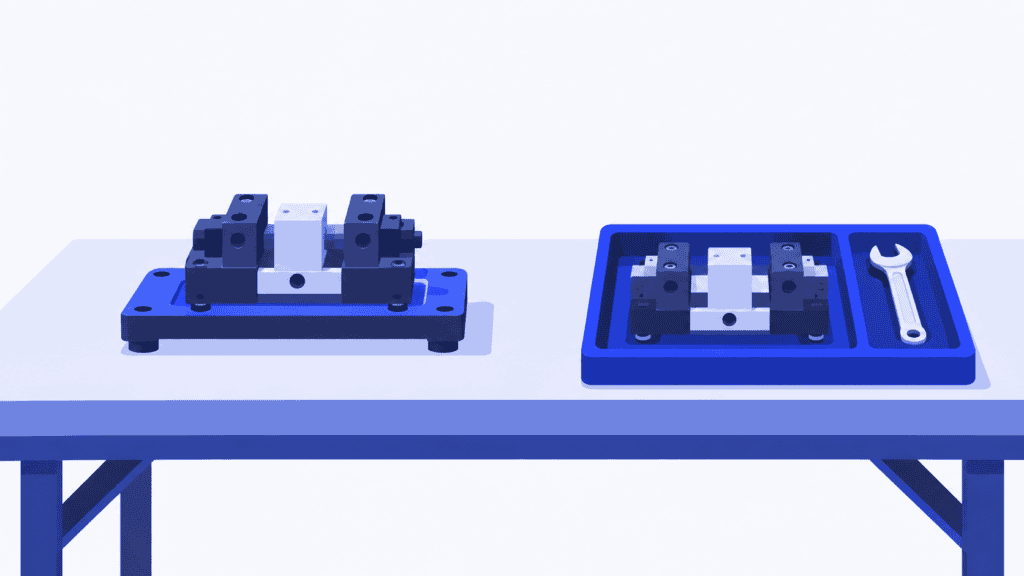
Internal setup requires the equipment to be stopped. External setup can be performed while it is running.
Observe the complete changeover and break it into individual tasks. Classify each task according to what actually requires the stoppage, rather than assuming that everything currently done during the stoppage belongs there.
For example, searching for the next tool may happen after the machine stops today. That does not necessarily mean the search requires a stopped machine. Removing a fitted tool, by contrast, may require the equipment to be stopped and made safe.
2. Move suitable preparation outside the stoppage
Prepare the next job before the current one finishes wherever this is safe and practical. The LeanProduction guide includes gathering tools and materials, inspecting parts, and preparing an additional fixture as ways to move preparation outside the stoppage.
Check that the required items are present and ready to use. If a fixture can be prepared separately, assess whether doing so removes work from the stopped-machine period.
Do not bypass guarding, isolation procedures or necessary quality checks. A task is suitable for external setup only when the team can carry it out safely without disrupting the running operation.
3. Simplify the remaining internal work
Review the tasks that still require a stoppage. Improve tool availability, standardise the sequence and reduce unnecessary adjustment. Assess fastening changes or parallel work against the site’s equipment and safety requirements.
Test the revised method through a complete changeover, including the return to acceptable production. Document the sequence so that the improvement does not depend on one operator remembering an informal shortcut.
Measure again using the same boundary as the baseline. Keep the observations with the documented method, and use them to update the setup-time assumptions in production planning.
Reduce avoidable changeovers with a better job sequence
Once the necessary changeover work is understood, examine the order in which jobs reach the machine. Similarity can depend on material, colour or dimensions, not only on a shared product code.
As an illustration, consider jobs that alternate between two materials. Grouping the jobs for one material together, followed by those for the other, can avoid repeated material changes. This is a sequencing example, not a customer result or a promise that every setup disappears.
Choose a similarity property that genuinely affects preparation at that workstation. Two jobs with the same material may still need different tooling or settings. Grouping them does not remove every other source of changeover work.
SMED and sequencing therefore need different measures. A shorter individual stoppage indicates a changeover-method improvement. Fewer changes of the selected property indicate a sequencing improvement. Either can help, but neither alone proves that the overall production plan is better.
Keep due dates and usable capacity in the decision
A long run of similar jobs can save preparation time and still be the wrong production decision. It may push an urgent order back or rely on material that is not available when the run is due to start.
Compare the potential setup benefit with order completion dates, material availability and usable workstation capacity. Decide which priorities matter for the current workload before changing the sequence.
SkyPlanner’s Dynamic Priorities includes factors such as lead time, completion date, customer importance and duration. Planners set the priorities; the AI follows those priorities when building the schedule. Similarity is a planning preference to balance with the rest of production, not an instruction to group every similar job regardless of the consequences.
Configure similarity-based sequencing in SkyPlanner
SkyPlanner supports grouping jobs by a workstation property such as colour, dimensions or material. Its documented similarity settings combine the property choice, setup time for differing jobs and a priority weight for consecutive similar jobs.
To configure this approach:
1. Give the Allow similar jobs factor importance in Dynamic Priorities.
2. Open the workstation’s settings and enable Allow similarity.
3. Set Setup time for differing jobs (min) to represent the time needed to switch between different properties.
4. Choose the property in Type of similar jobs.
5. Set the Similar jobs in succession priority weight.
6. Save the settings and recalculate the schedule.
Use a measured setup-time assumption that fits the workstation and the selected property. The setting supports setup-aware sequencing; it does not make the physical tool or material change happen faster. Improving that work remains the role of the changeover method and the production team.
Setup savings need to fit the rest of the plan. SkyPlanner’s production scheduling software uses the priorities you set to build a production schedule. SkyPlanner integrates with any ERP or MES system through its open REST API, so integration can connect production scheduling with the systems that hold your production data.
Check whether the new plan improves production
After changing the method or the sequence, compare actual changeover counts and the stopped production time they consume across comparable workloads. Also check order completion and the return to acceptable production after each changeover.
Ask three questions:
- Did necessary changeovers become shorter using the same measurement boundary?
- Did the new sequence avoid changes of the selected property?
- Did the plan preserve the required balance between completion dates, available materials and capacity?
Fewer changeovers are not enough if orders are merely delayed or startup quality deteriorates. Keep the revised method documented and update the setup time used in planning as measurement improves. This is a production evaluation process, not a claim that SkyPlanner automatically measures changeover time.
To discuss similarity-based scheduling for your production, Book a demo. Bring the property that drives your changes, your measured changeover time and your most important completion-date priorities.
Frequently asked questions
What is SMED in manufacturing?
SMED is a method for reducing equipment changeover time. It separates internal tasks, which require stopped equipment, from external tasks, which can happen while equipment runs. The team moves suitable preparation outside the stoppage and simplifies the remaining work.
Does SMED mean every changeover takes one minute?
No. Single-Minute Exchange of Die refers to a target of single-digit minutes, or less than 10 minutes. It does not promise a one-minute changeover or guarantee that every process reaches that target.
How do you measure setup or changeover time?
Use a consistent boundary from the last good part of the previous product at full production speed to the first good part of the next product at full production speed. Record the individual tasks as well as the total time. Do not stop measuring at machine restart if acceptable production has not returned.
What is the difference between internal and external setup?
Internal setup requires the equipment to be stopped. External setup can be performed while it runs. Moving preparation outside the stoppage must respect the equipment’s safety requirements and must not bypass necessary quality checks.
Can job sequencing replace SMED?
No. Sequencing can avoid some repeated property changes by grouping similar jobs. SMED improves the physical work of the changeovers that remain. Both need to fit the production plan.
How does SkyPlanner help reduce unnecessary setups?
SkyPlanner lets planners select a similarity property at a workstation, define setup time for differing jobs and weight consecutive similar jobs in the priorities. This supports setup-aware job sequencing. It does not shorten the machine’s physical changeover work by itself.
Should similar jobs always run together?
No. Planners also need to consider completion dates, materials and capacity. Grouping similar jobs is useful when its preparation benefit fits those priorities, rather than delaying more important work.
Jussi Mäntylä
Production Planning Specialist, SkyPlanner


