








In this article
- What is line feeding logistics?
- Line stock, kits or sequenced parts: which should you choose?
- Keep common parts simple with line stocking
- Use kits when preparation removes a real assembly problem
- Use sequenced supply when space savings justify sequence dependence
- Make the whole feeding policy work together
- 1. Define the signal and the response
- 2. Choose the source location
- 3. Match transport to the prepared load
- 4. Design the point of use
- Example: one assembly line, three supply policies
- Give line feeding a production schedule it can follow
- Protect the work already being prepared
- Material visibility makes a practical difference
- Start with one family and test the complete flow
Home » Resources » Line Feeding Logistics: Choose the Right Supply Method
Estimated reading time: 11 minutes
The racks beside the assembly line are full, but an operator is still waiting for a component. Elsewhere, a cart holds parts for a product that has just moved down the schedule. Adding more stock would make the aisle busier without necessarily fixing either problem.
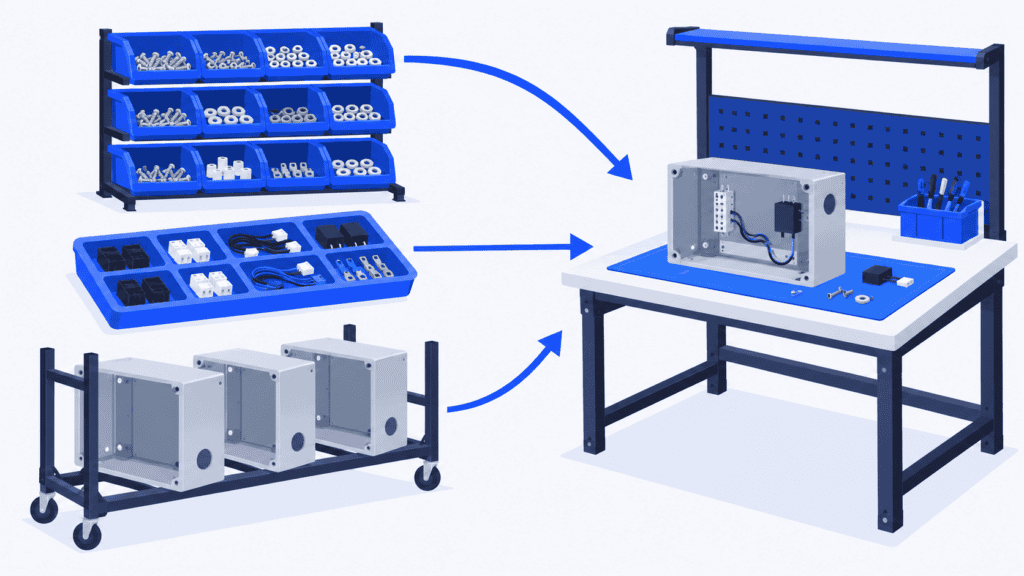
Better line feeding starts with choosing how each family of parts should reach the operator. Common fasteners may belong in replenished bins. Variant-specific components may work better in kits. A bulky assembly may need to arrive in production sequence rather than occupy a permanent line-side location.
Those choices also need a production plan that logistics can prepare against. SkyPlanner APS schedules work with material availability, operation dependencies and real capacity, reducing the manual work of matching parts to separate workstation queues. A deliberately protected near-term schedule gives your team a steadier window for preparing the right supply.
What is line feeding logistics?
Line feeding logistics is the internal supply of parts from storage or a preparation area to the workstations where they will be used. It covers the replenishment signal, the source location, the transport and the way parts are presented to the operator.
A line feeding policy combines those decisions for a part or group of parts with similar supply needs. Saying “we use kits” describes the presentation, but not what triggers preparation, where parts are picked or how they reach the station. Saying “we use a milk run” describes the transport arrangement, not whether the cart carries replenishment bins, kits or sequenced components.
This distinction matters when comparing methods. Kitting, kanban and milk runs are not three mutually exclusive alternatives. A consumption signal can replenish line-side bins through a milk run, while the same route also delivers kits prepared from a production schedule.
The aim is to minimize the total work and stock needed to provide dependable supply, not simply to move picking away from assembly.
Line stock, kits or sequenced parts: which should you choose?
Choose by part family before standardizing the whole line. Look at consumption, variant count, space, handling needs, picking risk and the stability of the production sequence.
| Supply method | A useful starting point | Main advantage | Trade-off to check |
|---|---|---|---|
| Line stocking: separate bins or containers of each part beside the station | Frequently used common parts with manageable space and clear identification | Simple access without preparing a separate kit for every job | Line-side stock, walking and selection effort grow as variants accumulate |
| Kitting: selected parts prepared together for a job, unit or defined group of operations | Variant-specific parts, difficult selection or limited space at assembly | Less searching and selection at the assembly station | Picking, checking, containers and handling move into preparation; missing parts need a clear response |
| Sequenced supply: parts arranged in the order the line will consume them | Variant components that are bulky or costly to keep in every version at the station | The next required variant can be presented without stocking all variants beside the line | A changed production order can require re-sorting or re-preparation |
These are starting points, not rules based on a universal number of variants or a fixed part value. The best choice depends on what the method removes and what it adds across the whole flow.
Keep common parts simple with line stocking
Line stocking makes sense when an operator repeatedly needs the same identifiable part and a sensible quantity fits close to the work. Small replenishment bins can be line stock just as larger containers can; line stocking does not automatically mean large bulk deliveries.
Before switching these parts to kits, ask what the extra picking would achieve. Counting the same common washer into every kit may add preparation work without removing a meaningful assembly problem.
The opposite problem appears when a common-part arrangement spreads to many similar-looking variants. More rack locations can increase reaching, searching and wrong-part risk. At that point, compare the actual selection work with preparing selected parts elsewhere.
Use kits when preparation removes a real assembly problem
Kitting can free valuable station space and make the required parts easier to identify. A stationary kit stays at the relevant station; a traveling kit accompanies the workpiece through the operations it serves.
The benefit is strongest when preparation removes repeated searching, sorting or walking from constrained assembly work. But the picking still exists. Include the time to prepare, check, deliver and return the kit container, not just the time saved at the station.
Also decide what happens to an incomplete kit. An apparently ready cart with one critical part missing can create a false start. Our kitting guide covers kit completeness and the handoff to production in more detail.
Use sequenced supply when space savings justify sequence dependence
Sequenced supply presents the required variant in the order it will be consumed. This can be useful for components whose alternatives would take too much room beside the line.
It is not the same as a complete kit. A rack of sequenced housings may supply only one component family, while other parts arrive in bins or kits.
The operational question is how long the sequence must remain dependable. Once parts have been picked and loaded, changing the production order has a physical cost. If that order changes frequently inside the preparation and delivery window, address the instability before relying on tight sequenced supply.
Make the whole feeding policy work together
After choosing the presentation, complete the other decisions. A good-looking kit cart is not yet a working supply process.
1. Define the signal and the response
For common repeat parts, consumption may trigger replenishment through an empty container or another defined signal. For job-specific parts, preparation may follow the approved production requirement and sequence.
Make the signal actionable: identify the part or job, quantity, destination, required time and person responsible for responding. If a replenishment request can wait unnoticed, the method is not reliable merely because the signal exists.
Set line-side coverage against the time from triggering replenishment to receiving usable parts. Include waiting for collection, picking, transport and placement. Use the expected consumption during that response time, including realistic variation, rather than relying only on a shift-average rate. Detailed route timing belongs in the milk run logistics plan.
2. Choose the source location
Parts might come directly from a central warehouse or through a nearby supermarket: a controlled replenishment area closer to production.
A nearby source can shorten the final supply response, but it also needs replenishment and space. Moving stock to a supermarket does not remove inventory; it changes where the stock and handling sit. Compare the complete warehouse-to-use flow before adding another storage point.
3. Match transport to the prepared load
A shared delivery route can carry several compatible loads. Some large or sensitive components may need a dedicated handling arrangement instead.
Check container size, loading and unloading effort, route capacity, access and the return flow for empties. More frequent deliveries are useful only if the transport and preparation work can actually support them.
The feeding policy decides what must arrive and when. Route design then checks whether the chosen transport can deliver it.
4. Design the point of use
Specify where the part will be placed and how the operator will identify and reach it. Consider packaging removal, component protection, empty-container space and any required lot or revision identification.
A delivery is not successful merely because the load reached the general area. The agreed destination and handoff must make the right parts usable for the intended work.
Example: one assembly line, three supply policies
Imagine an equipment assembly line using common screws, variant-specific electrical parts and large housings.
The screws stay in clearly identified replenishment bins at the stations. Consumption triggers replacement from a nearby supermarket, and a regular route exchanges the containers. The team checks that usable stock lasts through the full replenishment response.
The electrical parts are prepared as job-specific kits. Preparation follows the approved near-term work, each kit identifies its job and destination, and the handoff checks completeness. The route can deliver these kits alongside the screws without making the two supply policies identical.
The housings occupy too much space to keep every variant beside the line. They are prepared on a rack in the accepted production order and delivered within the agreed window. A supervisor owns changes after preparation starts, including any necessary re-sorting.
Now an urgent order is proposed. The screws may need only a consumption check. The kit may need a different selection. The housing rack may need re-sequencing. Treating all three families as “material available” would hide very different consequences.
The right response is to check both the changed production schedule and the physical preparation already committed to it.
Give line feeding a production schedule it can follow
An available component does not by itself make a job ready to run. The preceding operation may be unfinished, the required workstation may be occupied or the right shift may not be available. Preparing materials against an isolated assembly list can therefore create carts of work that production cannot use yet.
SkyPlanner brings these constraints into one production schedule. Arcturus, SkyPlanner’s scheduling AI, calculates operations using their durations, eligible workstations, dependencies, shifts and configured capacity. With “Consider the materials” enabled, it also uses maintained inventory and incoming shipments when calculating start times.
That reduces the work of reconciling a material list with separate machine queues. When a material arrival or production priority changes, you can recalculate the schedule and review the effect on downstream work and delivery commitments in the Gantt view.
SkyPlanner integrates with any ERP or MES through its open REST API. Material quantities can be kept current through integration or managed in SkyPlanner’s Warehouse module. Your existing systems can keep their operational roles while SkyPlanner handles the production scheduling calculation.
For line feeding, agree what the material data means. Stock in a warehouse is not proof that a complete kit or the correct component has reached its point of use. Keep that physical readiness check in the supply process, and ensure the availability information used for scheduling reflects your agreed rules.
Protect the work already being prepared
A responsive schedule is valuable, but repeatedly changing the next jobs can waste preparation effort.
SkyPlanner’s Running Time Lock protects jobs within a rolling window measured from the present moment. Jobs inside that window cannot be rescheduled, giving the team a stable near-term plan to prepare against.
Choose that window with the people doing the picking and delivery. It should reflect the preparation your process commits to, not an arbitrary desire to freeze a whole week. Keep enough flexibility beyond it to respond to new information. If a genuine shortage makes protected work unworkable, resolve the exception rather than assuming the lock makes the parts available.
Material visibility makes a practical difference
At contract manufacturer Eskomatic, manually organized work queues and limited material visibility made shortages harder to anticipate. With SkyPlanner, the company reports clearer daily queues, more accurate delivery-date setting and fewer production stoppages caused by missing materials.
That experience shows the value of connecting materials with production scheduling. For an assembly planner, the same planning principle gives the supply team a more credible answer to “what are we preparing next?” Read Eskomatic’s SkyPlanner review for the full story.
Start with one family and test the complete flow
Choose a family with a visible problem: crowded racks, repeated searching, missing kit parts or frequent re-sorting. Record its current supply path and compare a proposed method under the product mix it must actually serve.
Watch the full flow, including preparation and returns. Does assembly spend less time finding parts? Has that work simply become extra picking elsewhere? Are parts usable at the required station and time? How much stock and floor space does the arrangement need? What happens when the next jobs change?
Agree who responds to shortages and sequence changes before expanding the method. Revisit the policy when variants, consumption, packaging or layout change. A sensible line feeding system can use several methods; consistency comes from clear rules, not identical containers everywhere.
To connect those rules with a workable production plan, book a SkyPlanner demo. Bring one part family, the jobs that consume it, how you confirm usable availability and the preparation window you need to protect. You can examine how a material-date or priority change affects the production route without manually rebuilding every queue.
Prefer to explore scheduling first? Try SkyPlanner with demo data or the AI-assisted Getting Started flow in SkyPlanner Assistant.
Jussi Mäntylä
Production Planning Specialist, SkyPlanner


