








In this article
- What is a milk run in manufacturing?
- When does a milk run make sense?
- Design the replenishment loop before fixing the timetable
- Start with consumption at each workstation
- See how a half-hour route can create an hour of waiting
- Make the whole round fit the interval
- Check the load and the return path
- Pilot one route and investigate the right failures
- Give the supplied work a realistic place in production
- What this looks like in a customer’s production
- Connect your material decisions to the factory schedule
Home » Resources » Milk Run Logistics: Keep Factory Materials Moving
Estimated reading time: 10 minutes
Imagine a material-delivery vehicle that visits every half hour. The assembly cell still runs out of parts. The route is regular, but the replenishment is too late.
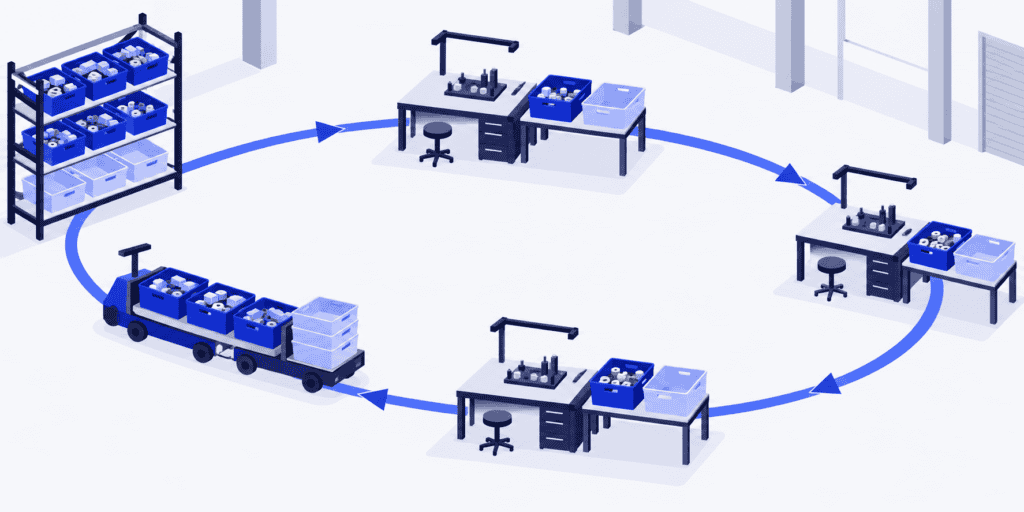
That is the difference between having a milk run and having one that works. Milk run logistics uses a recurring route to collect or deliver materials at several stops. Inside a factory, it can replace repeated individual supply trips with a predictable round that delivers parts and takes empty containers back.
The useful question is not just “Can we drive this route every 30 minutes?” It is “Will each workstation have enough usable material until its replenishment arrives?” Answer that first. Then connect material availability to the production plan. SkyPlanner APS helps you schedule the work that consumes those materials alongside the rest of the factory, without rebuilding every dependent machine queue by hand.
What is a milk run in manufacturing?
An internal milk run is a repeated material-supply round between a source, such as a warehouse or a supermarket (a controlled replenishment store), and several production workstations. The route and visit interval are defined; the load can change with consumption. Full containers go to agreed delivery points, while empties and replenishment signals return through the supply loop.
The same term also describes external logistics: for example, a truck collecting parts from several suppliers before returning to a factory. This guide focuses on internal production supply, where the important handover is from available stock to the workstation that needs it.
A milk run and Kanban do different jobs. Kanban authorizes replenishment after consumption. The milk run moves the material. An empty container may serve as the signal, but recognizing that signal does not mean its replacement is already on the way.
Keeping those roles separate helps you diagnose shortages. Did the station signal too late? Was nothing available at the source? Did picking miss the departure? Or did the vehicle reach the station after its remaining stock ran out? Each problem needs a different response.
When does a milk run make sense?
Start with material streams, not with a vehicle purchase. A good candidate has recurring demand across several nearby destinations, manageable containers and a supply source that can prepare replenishment reliably. The repeated round earns its place by serving several needs together.
Look at the pattern within a shift. A part used steadily across the day is a different proposition from a bulky component needed once for a special order. An average daily quantity can make both look suitable even though their transport needs are very different.
| Material-flow situation | Sensible starting choice |
|---|---|
| Several cells repeatedly consume small containers of common parts | Test a shared milk run with a defined replenishment signal and visit interval. |
| One destination absorbs nearly a full vehicle load each visit | Compare dedicated supply rather than adding unrelated stops. |
| Large or expensive parts are needed at specific, irregular times | Consider a separate timed delivery instead of holding them in every round’s buffer. |
| Stops rarely need anything and most rounds carry little | Reconsider the route size or use demand-led supply. |
| Consumption changes sharply when the product mix changes | Check the busy mix explicitly before choosing a fixed interval and container quantity. |
A mixed approach is often the practical answer: a recurring round for suitable parts and a defined exception process for the rest. You do not need every material in the factory on one route to benefit from milk run logistics.
The potential gains are straightforward. Shared rounds reduce separate supply trips, and a reliable replenishment interval lets you plan smaller line-side quantities. Operators can spend less time chasing parts. Those gains depend on the whole loop working; a lightly loaded vehicle is not proof of failure, and a full one is not proof that production is being served well.
Design the replenishment loop before fixing the timetable
A route drawing shows where the vehicle goes. A working supply design also explains what triggers replenishment, when the source learns about it, and which visit brings the replacement.
Start with consumption at each workstation
For each part and destination, establish the container quantity, expected consumption during the relevant production mix, delivery point and space available. Include the source location and the person or process responsible for preparing the next load. A plan for every part is a useful home for this information.
Then follow one container through the loop. When does it become empty? How is that communicated? When can picking begin? Is the replacement prepared for the next visit or the one after that? Measure the time from the actual trigger to usable material at the station, not merely the driving time from the warehouse.
This is the replenishment interval the remaining stock must cover. Add a deliberate allowance for the variation you intend the system to absorb. Do not hide that allowance inside an unexplained extra pile of containers.
See how a half-hour route can create an hour of waiting
Imagine an assembly cell using 60 identical parts per hour during a steady production period. Each container holds 20 parts, and the milk run visits every 30 minutes.
One container lasts 20 minutes. One visit interval consumes 30 parts. Neither fact, on its own, tells you how many containers belong in the replenishment loop.
Suppose the driver collects an empty container as the replenishment signal. It becomes empty just after a visit. The driver collects it on the next round, almost 30 minutes later. The replacement is then prepared at the source and delivered on the following round. The signal-to-replacement wait is almost 60 minutes, assuming preparation fits that cycle.
At the assumed consumption rate, the cell needs almost 60 parts during that wait: three full containers’ worth of remaining supply. That is before any chosen protection for delays or consumption variation. Counting only the 30 parts used between visits would miss half the wait.
If a request reaches the source early enough for picking and loading before the next departure, a replacement may arrive on the next visit instead. That is a different information flow, not a benefit you get merely by keeping the same route.
Use the timing of your actual signal and preparation process to size the loop. A “two cycles” rule is not a universal answer for every milk run, and the number of containers circulating is not the same as the space occupied at the workstation at every moment.
Make the whole round fit the interval
Build the timetable from observed work. Include travel, stops, delivery handling, empty-container collection, signal handling, unloading returns and preparing the next departure. A route that takes 20 minutes to drive may take much longer to operate.
For example, assume a proposed 30-minute round needs eight minutes of travel, ten minutes of stop handling, five minutes to unload returns and load the next round, and three minutes for checks and signal processing. That is 26 minutes, leaving four minutes before the next scheduled departure.
Those are illustrative assumptions, not a recommended allowance. Test whether the margin survives your normal variation, breaks and shift handovers. If the full work cannot fit, change the stop grouping, handling method, supply arrangement or frequency. Do not make the timetable work on paper by leaving necessary work out.
Check the load and the return path
Check the busiest plausible round, not just the average one. Can its full containers be carried and delivered in the required sequence? Where do empties go as deliveries progress? Does each station have enough agreed space for the material it receives?
Use the equipment’s approved limits and your site’s traffic and handling requirements. Vehicle selection and traffic arrangements need a site-specific assessment; a route sketch is not that assessment.
The return leg deserves the same attention as delivery. Missing empties, unclear signals or a queue of containers waiting to be refilled can break the next round even when the current one arrived on time.
Pilot one route and investigate the right failures
Choose a bounded set of stations and parts, name the route owner, and agree what happens when a request cannot be filled. A shortage needs an escalation path before the driver discovers it at departure.
During the pilot, record planned and actual visits, requests left unfilled, emergency deliveries and any station shortage while usable stock was still at the source. Also observe what operators do: a route is not succeeding if they still leave their workstations to fetch parts.
Review the evidence by cause:
- A late visit points you toward route work, interruptions or departure discipline.
- An on-time visit with the wrong load points you toward signals, preparation or identification.
- A correct delivery followed by a shortage points you toward consumption, container quantities or the replenishment timing assumption.
- Persistent excess at a station points you toward the same assumptions in the other direction.
Test representative busy periods and product mixes before extending the route. Compare production interruptions and emergency work as well as transport effort. Otherwise, an apparently efficient round can simply transfer the cost of waiting to production.
Give the supplied work a realistic place in production
A successful round answers a physical question: how do parts reach the workstation? Production planning must answer another: when can the work using those parts run, given all the other demands on the factory?
Stock in the warehouse does not, by itself, prove that a component is at the point of use. Keep that handover explicit in your material-supply process. Production’s availability information needs to reflect the agreed operating reality, rather than treating a stock balance as live delivery confirmation.
SkyPlanner APS is the right next step when you are manually reconciling material changes with machine queues. With material-aware scheduling enabled, it considers the recorded availability of materials used by production jobs. Arcturus schedules those jobs against the configured workstations, shifts, priorities and operation dependencies. The Gantt view shows the resulting sequence and its effect on completion dates.
That gives you a common production plan instead of a materials list and a separate set of machine queues to reconcile. When availability changes, the scheduling calculation handles the affected work together, leaving you to decide priorities and review delivery commitments.
For example, imagine a purchased component feeding assembly through your internal supply process. Its supplier arrival is delayed. In SkyPlanner, the purchase order’s delivery date represents expected material availability; confirming it as Delivered updates stock. Update the expected arrival and recalculate the schedule, and the affected production work is aligned with that date alongside the factory’s other constraints.
Now the planner can assess the production consequence before asking internal logistics to rescue an impossible start. The internal round still needs to deliver the component to its agreed destination. Purchase-order scheduling does not replace that physical handover.
What this looks like in a customer’s production
At sheet-metal contract manufacturer KJH-Comp, C9000 and spreadsheets once provided coarse weekly loading, while day-level machine assignment stayed manual. The company kept its ERP and introduced SkyPlanner for finite-capacity scheduling.
In KJH-Comp’s implementation, a pre-welding collection step checks that all the parts for a job, including purchased parts, are ready before it enters the work queue. SkyPlanner also handles machine assignment, and the supervisor can see bottlenecks in the schedule.
The relevant lesson is the connection between readiness and the next production job. It is the same connection you need after designing a material-supply round: the factory should sequence work around what can actually be done, not just around a weekly total. Read KJH-Comp’s SkyPlanner review for the full implementation story.
Connect your material decisions to the factory schedule
Use milk run logistics where repeated shared deliveries suit the material flow. Make its signals, preparation work, return flow and station coverage explicit. Then use SkyPlanner to keep the consuming production work aligned with maintained material availability and real capacity.
SkyPlanner integrates with any ERP or MES through its open REST API. You can keep the systems that manage your orders and connect their production data to a common schedule, reducing the manual work of matching material changes to machine queues.
Book a SkyPlanner demo around one component, the jobs that consume it and a delayed arrival. Ask to see which operations move and what happens to the delivery dates. It is a practical way to judge the value for your own production. If you prefer to explore first, try SkyPlanner with demo data.
Jussi Mäntylä
Production Planning Specialist, SkyPlanner


