








In this article
- What is SKU rationalization?
- Start with the complexity you want to remove
- Build a useful picture of each candidate
- Make a keep, change or retire decision
- Keep a variant when its role justifies the burden
- Change how you supply value before removing it
- Retire duplication that no longer earns its place
- Example: three enclosure variants, different decisions
- Turn the approved mix into a workable schedule
- Control the changeover between old and new products
- What Mamec’s experience shows about execution
- Review the result, not just the SKU count
Home » Resources » SKU Rationalization in Manufacturing: What to Keep
Estimated reading time: 10 minutes
Your lowest-selling variant might be easy to make. It uses the same material as a bestseller and runs alongside it with little extra setup. Another variant sells more but repeatedly interrupts your busiest machine, needs dedicated components and leaves material behind after every batch.
A sales ranking will not tell you which one deserves a place in the range. Good SKU rationalization connects what customers value with what the factory must do to supply it. The goal is a more profitable, manageable product mix, not simply a smaller catalog.
Once you have agreed what to keep, SkyPlanner APS turns the approved orders into a production schedule that accounts for materials, setup times and available capacity. You can see the work that remains and its delivery consequences without rebuilding each machine queue by hand.
What is SKU rationalization?
SKU rationalization is the process of reviewing individual stock keeping units to decide which to keep, change, consolidate or discontinue based on demand, economics and their role in the product range. An SKU identifies a distinct item, such as a particular size, finish or packaging configuration.
In manufacturing, the decision reaches beyond finished-goods stock. Each variant can bring its own components, tooling, inspections, setup requirements and production route. Removing a duplicate may simplify all of those. Removing an important customer option may lose far more business than that item’s sales suggest.
The useful question is: does this variant create enough value to justify the additional work and resources it requires?
That makes rationalization different from inventory classification. ABC analysis helps rank items by a chosen value measure; XYZ analysis describes demand variability. Both can help select candidates for review. Neither decides whether a low-volume spare part, customer-specific variant or shared component should disappear.
Start with the complexity you want to remove
Choose a product family with a recognizable problem: too many short runs on a constrained line, dedicated materials becoming obsolete, near-identical options splitting demand, or a catalog that has outgrown its customers’ needs.
Define the outcome before discussing a target SKU count. If the problem is coating-line changeovers, retiring items that already share a coating run may achieve little. If the problem is obsolete purchased components, consolidating those components across retained products may help more than deleting a finished-product code.
There are two different kinds of variety to consider. External variety is the choice the customer sees. Internal variety is the collection of parts, materials and processes needed to provide it. Engineering may be able to reduce the second without reducing the first, for example by using a common blank or fastening arrangement across several products.
Bring sales, product management or engineering, finance, purchasing and production into the review. Each answers a different part of the decision. Sales explains the customer need; engineering checks equivalence; finance tests the economics; purchasing and production identify the burden that would actually change.
Build a useful picture of each candidate
Use a consistent review period that covers the family’s normal demand cycle. Separate genuinely declining products from seasonal demand, launch-stage products and items that sold little because they were unavailable. A stockout is not evidence that customers no longer want the product.
For each candidate, connect commercial evidence to manufacturing evidence:
| Evidence | What to establish before deciding |
|---|---|
| Demand and lifecycle | Sales quantity and value, order frequency, trend, seasonality and whether the item is new, mature or approaching retirement |
| Customer role | Who buys it, what need it meets, whether an accepted substitute exists and what other business depends on it |
| Economics | Current material and processing costs, setup and support effort, selling price and the costs that would actually stop if the item were retired |
| Materials and stock | Shared versus dedicated components, supplier minimums, remaining stock, work in progress and outstanding purchases |
| Production burden | Routing, batch frequency, setup requirements, eligible resources and time on the constrained operation |
| Obligations and transition | Accepted orders, service commitments, approval requirements, substitution work and the practical exit date |
Do not let an uncertain cost estimate become a precise-looking verdict. Check whether the bill of materials and routing reflect how the product is made today. A standard cost based on long runs can hide the burden of the short batches you now produce.
Also distinguish cost removal from capacity release. Retiring a variant does not automatically remove rent, salaried supervision or equipment costs allocated to it. It may free time that you can use for other profitable work. That is valuable, but it is a different benefit from a cash expense disappearing.
The location and timing of that time matter. Freeing an hour on an already underloaded workstation is not the same as freeing an hour on the resource delaying customer orders. Assess the candidate alongside the work competing for that resource, not only as an isolated unit cost.
Make a keep, change or retire decision
A useful decision records the action, the reason, the owner and the conditions under which it will be reviewed. There is no universal sales cutoff that can replace this judgment.
Keep a variant when its role justifies the burden
A low-volume item may complete an important customer’s range, support equipment already in service or meet a requirement that a standard variant cannot. It may also share so much material and setup work with other items that its additional manufacturing burden is modest.
Make the exception specific. Name the customer need or service commitment and agree how it will be supplied. “Sales wants to keep it” is not enough evidence; neither is “it is in the bottom sales category” enough reason to retire it.
Change how you supply value before removing it
A useful product can have an unnecessarily expensive supply model. Consider a standard component, a common finish, an agreed order window, a revised minimum order quantity or make-to-order supply instead of holding finished stock.
These changes have trade-offs. A larger batch may reduce setup frequency while increasing inventory. A longer lead time may make production easier but be unacceptable to the customer. Check the total effect and agree the new terms rather than moving the cost or inconvenience elsewhere.
Where two variants appear interchangeable, have engineering and the customer confirm the relevant fit, function and approval requirements. Similar descriptions do not prove that one item can safely replace another.
Retire duplication that no longer earns its place
Retirement is a strong option when demand is weak, the item has no necessary role, and the cost or complexity of keeping it is not justified. It is easier to defend when customers accept a retained alternative and the associated materials or processes can genuinely be removed.
Decide what happens to the remaining stock and commitments before stopping supply. A signed-off retirement list should lead to a controlled phase-out, not an abrupt cancellation of work customers are still expecting.
Example: three enclosure variants, different decisions
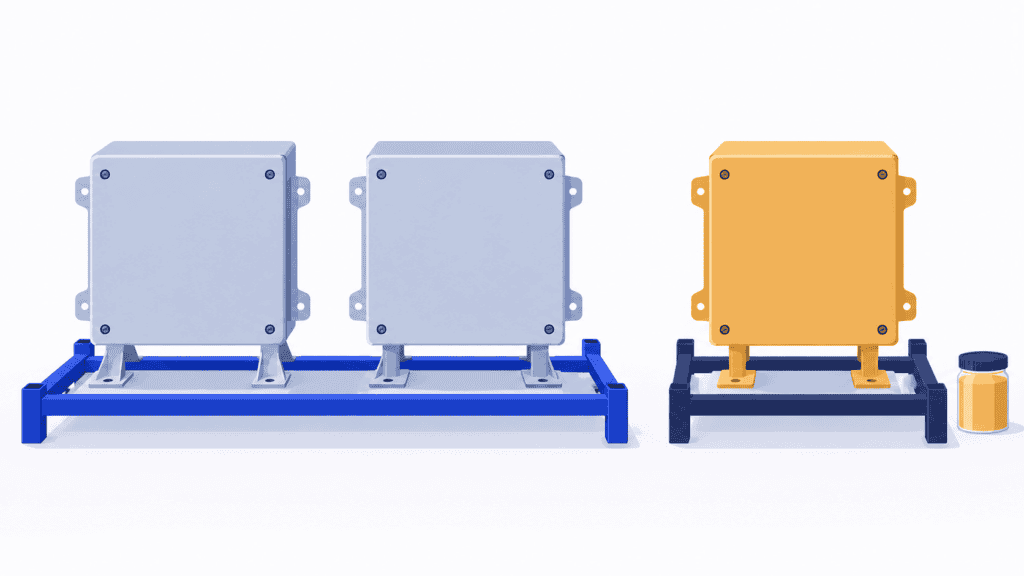
Imagine a manufacturer reviewing a family of industrial enclosures. Its standard grey enclosure sells regularly. A grey version with a different mounting arrangement sells infrequently, while a special-finish version also has low demand.
The mounting variant uses the same sheet material and coating as the standard product. It needs a different fabrication operation, but an important equipment customer orders it as part of a broader package. Removing it would not eliminate a coating changeover and could put that wider relationship at risk. The team keeps it, documents its customer role and agrees an order window that helps production combine compatible work.
The special-finish version needs dedicated coating material and a separate setup on the shared coating line. Sales checks whether its customers actually need that finish. Some accept the standard grey product. Another still needs the special finish and agrees to revised order quantities and lead times. The team consolidates the interchangeable demand and changes the supply terms for the remaining requirement.
If no customer needed the special finish and there were no remaining obligations, retirement could be the better decision. But low sales alone could not establish that.
The factory has now made a commercial decision with a manufacturing reason behind it. The next question is whether the retained orders, including the agreed special-finish batch, fit alongside the rest of the workload before their delivery dates.
Turn the approved mix into a workable schedule
This is where SkyPlanner becomes especially useful. A simpler catalog does not sequence the coating line, resolve a material shortage or protect tomorrow’s delivery by itself. The remaining products still compete for shared resources.
SkyPlanner connects product materials and process steps with the actual work to be scheduled. Steps can carry processing and setup times, eligible workstations and dependencies. Arcturus, SkyPlanner’s scheduling AI, uses the configured capacity, shifts, priorities and material availability to calculate the production schedule. The Gantt view makes the resulting sequence and timing visible.
For the enclosure family, product properties and workstation rules can group compatible coating jobs by color. Setup requirements remain part of the planning picture, while delivery priorities help steer the sequence. That gives the planner a practical way to manage the variety the business has chosen to retain, rather than treating every variant as an unrelated queue-building task.
Use SkyPlanner for the production consequences of the approved assortment: what work runs where, how it shares capacity and which deliveries need attention. Keep the customer and product decision with the people responsible for it. Your team decides the range and scheduling priorities; Arcturus handles the scheduling calculation.
Control the changeover between old and new products
Before recalculating the schedule, agree the transition details:
- The last date for accepting orders for a retiring variant, and the commitments that still need to be fulfilled.
- The approved replacement item or revised specification, with a clear effective date.
- What to do with existing stock, work in progress, dedicated components and outstanding purchases.
- Which live orders need changes to materials, process steps or quantities, and which must continue unchanged.
- Who updates the commercial offer, production data and purchasing instructions.
Updating a product master is not the same as approving a change to work already in progress. Reconcile the affected orders explicitly so the shop does not manufacture an obsolete revision or silently substitute a product the customer has not accepted.
Then calculate the approved workload in SkyPlanner alongside the factory’s other orders. Review the constrained resource and the resulting completion dates before making new delivery promises. You gain a shared production plan instead of leaving each supervisor to interpret the rationalization list independently.
SkyPlanner integrates with any ERP or MES through its open REST API, so you can connect the order and production data in your existing systems with finite scheduling.
What Mamec’s experience shows about execution
Mamec, a manufacturer of mixing technology and high-tech contract products, faced thousands of interdependent work orders and a production picture built around paper orders and subjective load estimates. Its customer-driven product development also involved frequent changes to manufacturing sequences.
With SkyPlanner integrated with Oscar ERP, Mamec gained a shared view of production and automated finite scheduling. The company reports a clearly lighter planning workload and easier change management: the effects of sequence changes can be worked out with less effort, helping it explain what can be promised to the customer.
That experience illustrates the execution benefit: when products and their manufacturing requirements change, the factory needs an updated plan, not another round of manually assembled queues.
Review the result, not just the SKU count
After the transition, check whether the original problem improved. Look at setup frequency and time on the affected resource, dedicated stock remaining, work in progress, delivery performance and customer retention. Review contribution and actual spending changes separately from capacity you have freed for other work.
A lower SKU count with the same changeover burden is not much of an operational success. Nor is a leaner catalog that drives an important customer to another supplier. The strongest outcome is a range that earns its complexity and a factory that can supply it efficiently.
Keep that discipline when approving new variants. Require a customer reason, a manufacturing assessment and a future review point so exceptions remain deliberate rather than accumulating unnoticed.
To put your approved product mix into practice, book a SkyPlanner demo. Bring a few retained variants, their orders and the resource they share. See how materials, setup requirements and delivery priorities become one workable production schedule. If you prefer to explore first, try SkyPlanner with demo data.
Jussi Mäntylä
Production Planning Specialist, SkyPlanner


