








In this article
- What is a two-bin system?
- How the equal-bin cycle works
- Choose parts whose demand and supply fit the method
- Size the reserve for the whole replenishment response
- An illustrative two-bin example
- Must both bins hold the same quantity?
- Give every empty-bin signal an owner
- Treat reserve consumption as a normal signal, but a late refill as an exception
- Schedule in-house refills with the work they compete against
- What material visibility changed at Eskomatic
- Start with one part and prove the complete cycle
Home » Resources » Two-Bin System: Keep Small Parts Ready for Production
Estimated reading time: 10 minutes
An assembly station runs out of a small part. There is stock somewhere in the factory, but someone has to find it, request a refill and bring it to the operator. A low-cost component has just interrupted valuable production time.
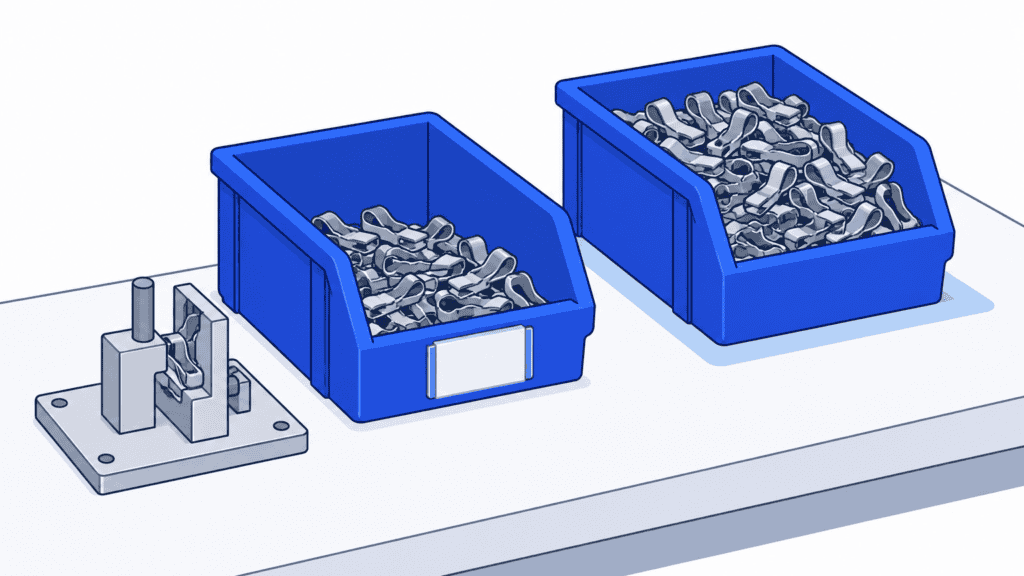
A two-bin system makes that need visible before the workstation runs dry. Operators consume from one bin while the other waits in reserve. Emptying the first bin triggers replenishment; the second keeps production supplied while replacement arrives.
The important question is not whether you have two containers. It is whether the refill can return before the reserve is gone. For parts you manufacture on shared machines, SkyPlanner APS helps you answer that question by scheduling accepted replenishment work alongside customer orders, rather than leaving it on a separate refill list.
What is a two-bin system?
A two-bin system is a visual replenishment method in which two defined quantities of the same item support a repeating consumption-and-refill cycle. One bin supplies the point of use. When it empties, a card, the empty container or another agreed signal requests replacement, and consumption switches to the second bin.
The second bin provides stock for the response period. The benefit is simple: the operator does not need to count every remaining part to recognise when replenishment is due. The physical change makes the need obvious.
In manufacturing, the method is especially useful for regularly used fasteners, fittings and other small repeat components. It can replenish from a central store, an external supplier or an internal production process. The source changes the work behind the signal, but not the need for a reliable response.
How the equal-bin cycle works
For a straightforward pilot, use two bins with the same standard quantity:
1. Consume from one bin only. Keep the second clearly identified as the reserve, not an alternative picking location.
2. Signal when the active bin empties. Move the empty bin or its card to the designated collection point, or record the agreed electronic request.
3. Switch to the full reserve. Production continues while the refill owner arranges replacement.
4. Confirm the refill is being handled. The receiving owner acknowledges the signal and establishes when the usable parts should return.
5. Return the refilled bin as standby. Check the item and quantity, restore its identification and close the refill record. Keep consuming from the current active bin until it empties.
The bins then exchange roles again. Avoid continually topping up the active bin: that can conceal the depletion event that is meant to trigger replenishment.
Choose parts whose demand and supply fit the method
Start with parts that have repeat consumption, clear identification and a replenishment source you can depend on. The best candidates are easy to handle in a standard quantity and do not change specification from one job to the next.
A cheap part can be a good candidate even when its absence stops an expensive operation. Its purchase price does not tell you the cost of running out. Conversely, filling two large bins with an expensive, rarely used item can tie up money without solving a recurring supply problem.
Be more cautious when consumption is intermittent or dominated by occasional large orders. A single withdrawal may exhaust the reserve long before the usual refill can return. Order-specific components, frequent engineering revisions, short shelf lives or demanding lot-control requirements also need more than a convenient pair of containers. Keep the required identification, stock rotation and traceability controls in place.
Two-bin replenishment is related to kanban, but two bins do not mean two kanban cards. A two-card manufacturing loop distinguishes permission to produce from permission to move material. This article’s two-bin arrangement concerns the physical stock and the response when one quantity is exhausted.
Nor is it the same decision as a min–max policy. Min–max uses a reorder trigger and an order-up-to target; two bins make a particular consumption threshold visible at the point of use. A collection route can carry the empty and full bins, but a route alone does not acknowledge or complete the refill.
Size the reserve for the whole replenishment response
Measure the time from the consumption signal to usable replacement at the designated workstation. Do not stop the clock when a purchase order is sent, a machine finishes cutting or a delivery reaches the factory gate.
The response can include waiting for signal collection, checking and releasing the request, picking or manufacturing, inspection, transport and putting the parts back at the correct location. For in-house parts, time waiting for a shared machine may matter more than processing time.
As a starting calculation, multiply expected consumption per operating period by the number of operating periods exposed during that response. Then provide protection for the demand and response variation your process needs to withstand. Safety stock is the extra protection within the quantity, not necessarily the whole second bin.
An illustrative two-bin example
Imagine an assembly station using 40 clips per operating shift. Each bin holds 240 usable clips. When one empties and the operator switches bins, the full bin provides six operating shifts of supply at that consumption rate.
If the complete refill response takes four operating shifts, the station consumes 160 clips while waiting. The replacement returns with 80 clips still in the active bin. That remaining quantity is the example’s protection against variation, not a recommended allowance for every factory.
Now suppose the clips take only a short time to make, but the producing machine’s queue delays their return beyond six operating shifts. The system fails despite having the right containers and a visible signal. You must improve the response, provide more protection or choose a different replenishment arrangement.
Keep calendars consistent. If assembly consumes during a night shift but the store, supplier or refill process does not operate then, that gap still uses up protection. Base the calculation on the consumption that actually occurs while replacement is unavailable, not on an unexplained mixture of calendar days and working hours.
Must both bins hold the same quantity?
No. An unequal arrangement can use a larger working quantity and a smaller reserve sized to cover replenishment. But write a different reset rule for it: on receipt, restore the reserve to its specified quantity and place the balance in the working bin.
Do not alternate unequal bins as though each provided the same protection. For an initial rollout, equal quantities make the exchange easier to understand and audit. Choose unequal quantities only when the stock or space benefit justifies the extra discipline.
Give every empty-bin signal an owner
A card sitting in a tray is a request, not evidence that anyone has acted on it. Before launching the pilot, agree who receives the signal, how quickly they acknowledge it and who responds when replacement will be late. Assign the responsibility across shifts, including a backup when the usual owner is absent.
Keep the signal specific enough to act on without a phone call. Identify the part and revision where relevant, standard refill quantity, source, return location and bin or card identifier. The person handling replenishment should be able to distinguish this request from one already in progress.
For example, use an agreed status such as requested, accepted and returned. A paper signal can work perfectly well, provided the receiving owner acknowledges it and open requests remain visible. If the same request is also recorded electronically, connect the two records rather than launching a second refill.
The physical cycle and the inventory record must also agree. Moving a bin does not by itself establish an electronic stock transaction or create a manufacturing order. Decide when your chosen workflow records consumption, internal transfer, receipt and any production request. If stock has already been deducted through production reporting, avoid deducting it again merely because the empty container is collected.
At return, verify usable quantity, identity and location before closing the request. Damaged parts in a full-looking bin do not provide the intended protection. A replenishment is complete when the right usable parts are available to the consumer, not simply when someone marks an upstream task finished.
Treat reserve consumption as a normal signal, but a late refill as an exception
Using the second bin is expected. Reaching its end without replacement is not.
Set an escalation point early enough to act while stock remains. If the refill owner cannot confirm a return within the remaining coverage, involve the person who can change the supply or production decision. An emergency transfer may be appropriate, but record it and restore the two-bin quantities afterwards. Silent borrowing from another station only moves the shortage.
During the pilot, review missed acknowledgements, actual signal-to-return times, reserve remaining at return and emergency interventions. Use those observations to improve the collection and refill process before reducing stock. Review quantities again when demand, shifts, supplier performance or the production route changes.
Schedule in-house refills with the work they compete against
For purchased fasteners, the main response may be picking, supplier delivery and internal transport. For a clip, bracket or spacer made in-house, replenishment also competes with customer work for machines and time. A refill list that ignores those commitments is not a credible return promise.
Choose SkyPlanner when your replenishment needs that shared production capacity. Once a refill is accepted as a production order, Arcturus, SkyPlanner’s scheduling AI, calculates its operations together with the other work. It considers the configured workstations, capacity, shifts, operation dependencies and priorities. The Gantt schedule shows the resulting sequence and planned completion.
That saves the work of maintaining one queue for customer orders and another for refill batches, then trying to reconcile both by hand. You can see whether the refill fits before the reserve is expected to run out and what a priority change does to other commitments.
Return to the clip example. The useful planning question is whether the accepted replacement batch can complete its route in time for inspection and delivery back to assembly. If the shared machine is already committed, the conflict becomes a decision you can address before assembly is empty. You set the priorities; Arcturus calculates the schedule within them.
With material-aware scheduling enabled and stock information maintained, SkyPlanner also considers the materials needed for the refill. An available machine is not enough if the batch’s raw material is missing. For bought-in parts, maintained purchase-order arrival dates can be considered in the schedule of the work that needs them; recalculate when those dates change.
SkyPlanner integrates with any ERP or MES through its open REST API. You can connect existing order and inventory information to the production schedule instead of building an isolated replenishment-planning island. Keep the bin signal simple at the workstation and give the work behind it a plan that accounts for the rest of the factory.
What material visibility changed at Eskomatic
Eskomatic, a Finnish contract machining company, previously organised work queues largely by hand. Limited visibility into material availability meant shortages could surface too close to a job’s planned start.
With SkyPlanner connected to its existing ERP, the company gained a clearer visual work queue and automatic load scheduling. Eskomatic reports more accurate delivery dates and fewer production stoppages caused by material shortages.
Its experience shows the value of connecting material readiness with daily scheduling: planners can respond earlier instead of untangling the problem when work should already be running. For a two-bin refill made on shared machines, that is the same practical need—a return expectation supported by the actual production plan.
Start with one part and prove the complete cycle
Pilot a repeat part at one point of use. Confirm both starting quantities, reconcile any refill already open, label the locations and rehearse the empty-bin exchange with the operators and refill owners. Follow several complete cycles, including shift handovers, before expanding.
Keep what makes the two-bin system valuable: an obvious signal and an uncomplicated operator routine. Put the planning effort where it matters—making sure the response behind that signal can actually deliver.
To see how SkyPlanner would schedule your in-house replenishment, book a demo with one repeat part, its reserve coverage and a customer job competing for the same resource. You can examine the refill’s place in the shared schedule and the effect on other work. Or try SkyPlanner with demo data, using the Assistant’s AI-assisted Getting Started if you prefer a guided introduction.
Jussi Mäntylä
Production Planning Specialist, SkyPlanner


