








In this article
- What is root cause analysis in manufacturing?
- 1. Protect output and define one problem worth investigating
- 2. Build an evidence set that includes the good runs
- 3. Choose the RCA tool for the question you need to answer
- 4. Test the explanation before committing to the fix
- 5. Turn the verified cause into work the factory can complete
- Put the approved work into the SkyPlanner schedule
- 6. Verify effectiveness under the conditions that caused recurrence
- Bring one recurring problem into a better production plan
Home » Resources » Root Cause Analysis in Manufacturing: Stop Repeat Failures
Estimated reading time: 12 minutes
The rejected batch has been sorted, the machine is running again and the urgent order has left. Then the same problem returns after the next changeover. The response solved today’s interruption, but something in the process is still creating tomorrow’s failure.
Root cause analysis in manufacturing helps you find and address that recurring mechanism. Its value comes from connecting three things: evidence of what caused the problem, corrective action that people can actually carry out, and a check that the action worked under the conditions that previously produced the failure.
SkyPlanner helps connect the production side of that work. Job-level time and quantity records give your investigation a clearer starting point; the shared production schedule gives approved corrective work a place alongside customer orders. You spend less time piecing together reports and separate machine queues, and more time making the improvement happen.
What is root cause analysis in manufacturing?
Root cause analysis, or RCA, is a structured investigation into why a manufacturing problem occurred, so its underlying causes can be addressed rather than repeatedly treating the consequences. It can be applied to recurring defects, equipment interruptions, excessive processing time or delivery failures.
A symptom tells you what went wrong: holes are out of position, an operation overruns, or an order ships late. A causal explanation identifies the process conditions that produced that result. There may be several interacting causes, not one final answer hidden at the bottom of a five-question chain.
Keep three kinds of response distinct:
- Containment protects the current situation. Isolate suspect stock or add an approved temporary check so affected output does not move forward unchecked.
- Correction deals with the detected problem. Rework or replace the affected parts, for example.
- Corrective action addresses the cause of recurrence. Change the process condition that allowed the problem to arise.
All three can be necessary. Sorting a batch may protect the customer without changing the process that made the bad parts. Equally, an excellent investigation does not improve production until the agreed action is implemented.
1. Protect output and define one problem worth investigating
Do not wait for a completed analysis before following your site’s containment and escalation procedures. Then give the investigation a specific boundary. “Quality is poor” is too broad to test, while “the operator set it wrong” embeds an accusation before the evidence has been examined.
A useful problem statement names the product or process, the failed requirement, the affected place and period, and the scale of the deviation. Add what you know about where it does not occur. Bring together the people who can explain the work: the operator, quality representative, process engineer and relevant maintenance or planning specialist.
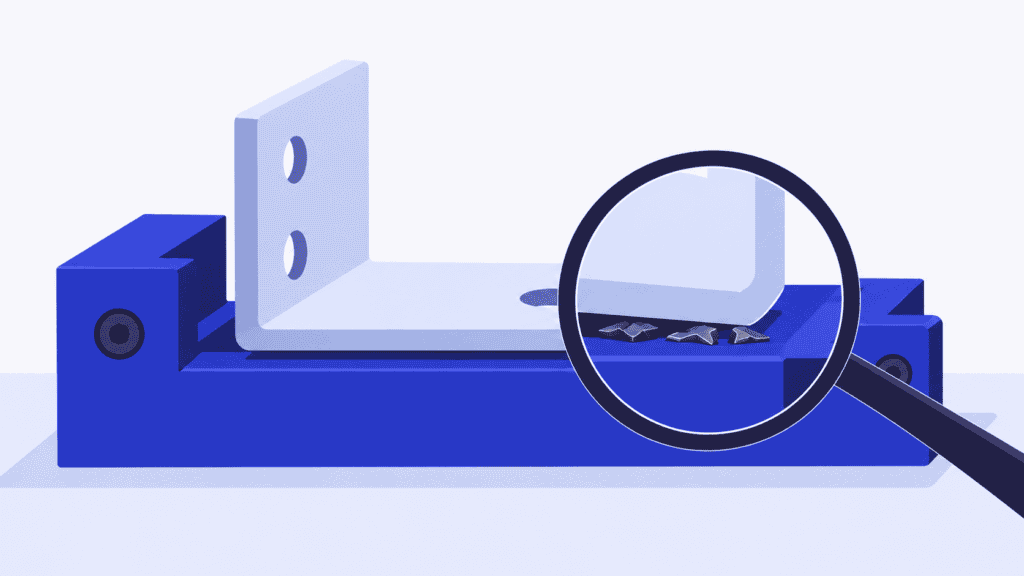
Imagine a machine shop making a family of brackets. Inspection has found mounting holes outside the drawing’s positional tolerance in several batches following a fixture changeover. Other batches of the same family have passed. The initial problem statement describes that difference; it does not yet name a worn tool, a bad fixture or a person’s mistake as the cause.
Choose one failure mode first. Combining hole position, surface finish and missing paperwork under “rejects” can bury three different investigations in one average. If you must prioritize several problems, rank them by a consistent measure such as frequency, lost time or cost of poor quality, while dealing with urgent customer and safety risks through the appropriate response process.
2. Build an evidence set that includes the good runs
Start close to the affected operation. Collect the job and batch identifiers, actual production times, quantities checked, the specific nonconformance and the sequence of relevant events. Add the evidence needed to examine the process: drawing and program revisions, tooling and fixture condition, material records, setup instructions and inspection results.
For the bracket problem, the useful comparison is not simply “Monday versus Tuesday.” It is the same product and requirement across failed and successful runs, with attention to what happened at changeover. Ask what differed in the fixture, setup sequence, program, material and checking method.
Check the measurement before treating it as unquestionable evidence. Were the parts assessed against the same requirement using a suitable, consistent method? If inspectors disagree, resolve that uncertainty before explaining a production difference that might be a measurement difference.
SkyPlanner’s Job Report shows recorded work against jobs, including the person and workstation, and supports comparison with planned durations. All Timelogs provides the timestamped work records. Produced and faulty quantities can also be recorded when job time logs are finalized. That helps you locate the affected work and see whether a quality problem coincided with extra processing time or repeated work.
Keep dimensional measurements, test results and quality approvals in your quality workflow, and connect them with the relevant production jobs. SkyPlanner’s production records help organize the investigation; a longer logged duration or a higher faulty quantity does not, by itself, explain the physical cause.
3. Choose the RCA tool for the question you need to answer
You do not need every analysis method for every problem. Use the simplest approach that can deal with the failure’s complexity and consequences, then go deeper if the evidence reveals interacting causes.
| Investigation question | Useful method | What it does not establish on its own |
|---|---|---|
| Which recurring problem deserves attention first? | Pareto analysis, ranking a defined frequency, time or cost measure | The mechanism causing the highest-ranked problem |
| What sequence of conditions could explain this failure? | 5 Whys, checking the evidence behind each answer | That a convincing chain of answers is true |
| What possible causes have we overlooked? | Fishbone diagram, grouping ideas under people, methods, machines, materials, measurement and environment | That a branch is a verified cause |
| What changed between successful and failed production? | Change analysis and comparison of affected and unaffected runs | That the most recent change must be responsible |
| How could several events combine, or a control fail? | Fault-tree or barrier analysis with suitable specialist support | That every mapped path actually occurred |
For the bracket problem, a fishbone can keep the team from discussing only tooling. Change analysis can then focus attention on the difference after fixture changeover. Use the 5 Whys to examine a supported causal path, not to turn the first suggestion into a conclusion. Five is a prompt, not a required number of answers.
Start with the failure, ask why it occurred, and use the supported answer as the next question. For example: why is the hole out of position? The part was not seated correctly. Why not? Chips remained on the locator. Why were they not removed or detected? The changeover method omitted cleaning and seating verification. Each answer needs observations or records; where evidence is missing, mark an open question. Branch the analysis when more than one condition matters instead of forcing everything into one chain.
If a customer or your quality system requires an eight-disciplines, or 8D, response, use that wider framework to manage the team, containment, analysis, action and closure. RCA is part of it, not a replacement for it. Failure mode and effects analysis, or FMEA, serves a different purpose: assessing potential failure risks. Update the relevant risk analysis with what the investigation teaches you, rather than treating a risk ranking as proof of what happened.
4. Test the explanation before committing to the fix
Turn each serious candidate into a testable statement. What would you expect to observe if it were true? Does it explain the failed runs, the successful runs and the timing? What evidence would contradict it?
For the imagined bracket problem, the team could investigate these alternatives:
| Candidate explanation | Evidence to examine | A useful challenge to the explanation |
|---|---|---|
| Cutting-tool wear shifts the hole position | Tool condition and usage alongside the inspection sequence | Do failures follow tool life, or do they appear immediately after a fixture change? |
| A program revision changes the location | The actual program revision used for affected and passing jobs | Does the same revision also produce conforming brackets under comparable conditions? |
| The workpiece does not seat consistently on the fixture | Locator condition, setup observations and dimensional results | Does verified seating change the result in an authorized trial while other relevant conditions remain controlled? |
Suppose the investigation finds chips at a locating surface, a corresponding seating error and a changeover instruction that does not require cleaning and verifying that surface. An authorized trial with the fixture correctly prepared produces conforming results. Together, these observations support a mechanism more strongly than “rejects rose on the late shift.”
The team should still examine competing explanations and the trial conditions. If tooling, material and the program were all changed at once, a good result would not reveal which change mattered. Use a planned trial or specialist experimental method appropriate to the uncertainty; do not recreate a hazardous condition to prove a point.
Now ask a second question: why did the failure escape the existing controls? Perhaps the first-off check did not include the affected dimension. That is different from the condition that created the seating error. Preventing the defect and detecting an unexpected recurrence may require different actions.
“Human error” is not a sufficient stopping point. Ask what made the error possible or hard to notice: an unclear instruction, inaccessible checking method, ambiguous fixture position or missing verification. The aim is a process that supports reliable work, not a person to attach to the report.
5. Turn the verified cause into work the factory can complete
Choose corrective actions that address the supported mechanism. In the fixture example, that could mean improving the locating arrangement, adding a clear cleaning and seating-verification step, and revising the first-off check. The appropriate combination depends on what the investigation actually establishes.
Give each action an owner, a completion point and an acceptance check. “Retrain everyone” is not a complete response if the instruction still leaves the critical condition undefined. “Update the procedure” is not finished when the document changes but the new method has not reached the people doing the work.
Implementation also needs capacity. Fixture modification may need a toolroom resource; a validation run may occupy the same machining centre already promised to customer orders. If that work remains on an improvement list outside the production plan, it can be postponed repeatedly or appear as another urgent interruption.
Put the approved work into the SkyPlanner schedule
Represent approved production-related corrective work as defined operations with realistic durations, eligible resources, dependencies and priorities. Include the trial-production work needed to validate the change, so the plan accounts for that capacity as well as the customer backlog.
Arcturus, SkyPlanner’s scheduling AI, calculates the sequence against the capacity and rules you configure. The Gantt timeline shows where the work fits and what the resulting completion dates mean for other jobs. You steer the priorities and protect scheduling decisions with rules and locks; Arcturus handles the connected scheduling calculation.
For the bracket shop, the practical question becomes: when can the fixture work finish, when can the trial run, and which customer jobs are affected? You can resolve that trade-off in one production plan instead of manually adjusting a toolroom list and several machine queues.
This is a strong reason to choose SkyPlanner when recurring quality problems keep becoming planning surprises. You gain a clearer connection between production evidence, the work the team has approved and the delivery commitments that work must fit around. SkyPlanner integrates with any ERP or MES through its open REST API, so you can connect existing production information with that shared schedule.
6. Verify effectiveness under the conditions that caused recurrence
An action being complete is not the same as an action being effective. Before implementation, agree what result will count as success, which production will be reviewed, who will review it and what will trigger reopening the investigation.
For the fixture example, checking one good batch is weak evidence if the problem appeared after changeovers. Follow repeated relevant changeovers, not just a convenient number of calendar days. Include the comparable starts within the agreed scope, including unsuccessful ones, and check that the new method is actually being used.
Compare the same failure definition, acceptance rule and measurement method. Keep product mix and exposure visible. As a purely illustrative follow-up, 24 nonconforming brackets among 600 inspected before the change is 4%; four among 800 inspected afterwards is 0.5%. That is an encouraging observed difference, not proof by itself that the corrective action caused it. A different product mix, inspection approach or set of operating conditions could change the comparison.
Use process-level results to assess the fix, and production records to understand its consequences. Has the specific dimensional problem recurred? Has repeat processing reduced? Is the added setup check practical within the work? Have you moved the problem elsewhere or created a delivery conflict?
If recurrence continues, revisit the causal explanation, the action’s design and whether it was implemented as intended. Do not close the report merely because the assigned tasks are marked done. When the evidence supports effectiveness, embed the successful change in the relevant instructions and controls, consider where else it applies, and remove temporary containment only through the appropriate approval process.
Bring one recurring problem into a better production plan
A useful root cause analysis ends with more than an explanation. Your team understands the failure, has evidence for the action it chose, and can show what happened when the revised process met real production conditions.
Choose SkyPlanner to make the production side easier to coordinate: recorded job performance for a focused investigation, approved corrective work in the shared schedule, and less manual rebuilding of the queues around it.
Book a SkyPlanner demo and bring one recurring deviation, the affected jobs and an approved corrective task that needs production time. Use that situation to explore how the evidence and the work can stay connected to your delivery plan. If you prefer to explore the environment first, try SkyPlanner with demo data.
Jussi Mäntylä
Production Planning Specialist, SkyPlanner


