








In this article
- What makes TPM more than preventive maintenance?
- The eight pillars: different jobs in one programme
- Choose a pilot with a real production problem
- Agree who acts when an operator finds a problem
- Restore the basic condition and make care repeatable
- Give agreed maintenance a place in the production plan
- Example: follow one finding through to improvement
- Measure the loss, not just the completed checklist
- Review the pilot, then extend what actually works
- Make the production side of TPM easier with SkyPlanner
Home » Resources » Total Productive Maintenance: From Plan to Practice
Estimated reading time: 12 minutes
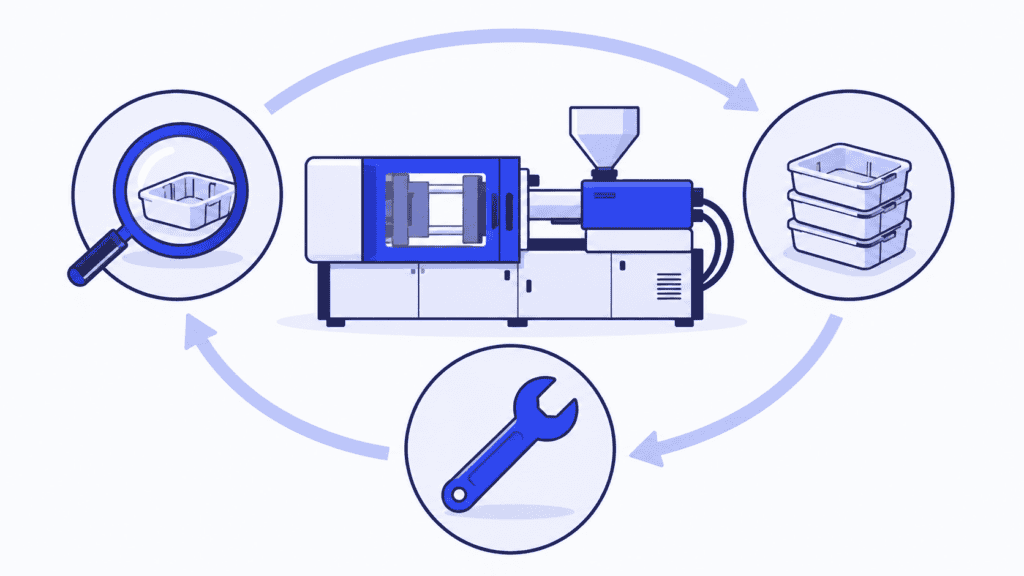
Total productive maintenance (TPM) is a company-wide approach to improving equipment effectiveness through routine care, planned maintenance and continuous improvement. Operators, maintenance specialists, engineers and managers work together to prevent the equipment losses that interrupt good production.
The difficult part is making that shared responsibility work on a busy shift. An operator reports the same small stop again. Maintenance knows the machine needs attention. Production needs the next order finished. Unless someone owns the response and there is time to act, the observation becomes another entry in a log.
A useful TPM programme connects those activities: recognize an abnormal condition, assign a response, carry out the work and check whether the loss returns. Start with one manageable area and build that complete routine before extending it across the factory.
What makes TPM more than preventive maintenance?
Preventive maintenance helps avoid failures through maintenance tasks performed at suitable intervals. TPM includes that work, but reaches beyond the maintenance department and beyond breakdown prevention.
“Total” has three important meanings. People across the business participate, equipment losses are addressed as a whole, and experience is used throughout the equipment’s life. Operators contribute their knowledge of daily running conditions; specialists bring diagnostic and maintenance expertise; engineering improves equipment and methods; management provides priorities and resources.
The losses include major downtime, setup and adjustment time, brief stops, reduced running speed, scrap and rework. A machine that never breaks down can still waste capacity by running slowly or producing parts that need correction. TPM asks the team to understand and reduce those losses, not simply achieve a clean maintenance record.
The benefit is more dependable productive time. Fewer repeat interruptions and equipment-related defects mean less wasted material, less emergency work and a more reliable basis for meeting customer demand. The team must still decide how to use that capacity profitably; making unnecessary stock is not an improvement merely because the machine stays busy.
The eight pillars: different jobs in one programme
TPM is commonly organized around eight pillars, supported by workplace organization such as 5S: sort, set in order, shine, standardize and sustain. The pillars describe the programme’s breadth. They do not require eight large projects to begin on the same day.
| TPM pillar | Its practical purpose |
|---|---|
| Autonomous maintenance | Train operators to perform defined routine care, recognize abnormalities and escalate work outside their authority. |
| Planned maintenance | Prepare and carry out appropriate maintenance before deterioration becomes an avoidable production failure. |
| Focused improvement | Bring relevant roles together to remove a specific recurring equipment loss and verify the change. |
| Quality maintenance | Maintain equipment conditions that support acceptable products, rather than repeatedly sorting out defects afterward. |
| Early equipment management | Use operating and maintenance experience when specifying, buying and introducing equipment. |
| Training and education | Develop the skills needed to operate, inspect, maintain and improve the equipment. |
| Safety, health and environment | Build safe working conditions and environmental responsibilities into equipment care and improvement. |
| Office TPM | Improve supporting work, such as information, purchasing and approvals, so it does not hold up effective production and maintenance. |
Use this map to check a proposed programme. If it consists only of cleaning checklists, who will remove the source of recurring contamination? If it consists only of specialist maintenance jobs, how will operators notice and report a developing problem? If the right part is never available, which purchasing or preparation process needs to change?
The pillars connect through the equipment problem being solved. That is a more useful starting point than assigning each department a presentation about its pillar.
Choose a pilot with a real production problem
Select an area where improving equipment performance would matter and where a cross-functional team can carry out the work. A manageable cell or machine with recurring, understandable losses is usually a better learning environment than a factory-wide launch with no clear owner.
Avoid choosing solely for convenience. A quiet machine may be easy to clean but reveal little about how production and maintenance will cooperate under normal pressure. Conversely, a safety-critical or highly complex asset may need specialist preparation before it is suitable for a first pilot.
Write a short pilot agreement with the production supervisor, maintenance lead and operators. Name the equipment, the loss to address, the person accountable for progress, the people contributing and the time and resources available. Include quality or engineering where the problem crosses their responsibilities.
Define the starting point before changing the work. Record when the loss happens, how long it interrupts production, what product or operating condition is involved and what is known about the cause. Distinguish an observation from a diagnosis: “machine stopped during startup” is evidence of an event, not proof that an operator, component or material caused it.
Choose a review period long enough to encounter representative running conditions and product changes. Agree what improvement would justify extending the pilot, without borrowing a universal OEE target or promising a fixed percentage gain.
Agree who acts when an operator finds a problem
Autonomous maintenance means trained operators taking responsibility for defined equipment care, not operators taking on every maintenance task. The programme needs a clear boundary between routine checks, authorized adjustments and work requiring a specialist.
For each task, define what to inspect or do, the normal condition, when it happens and the response to an abnormal finding. Support it with a usable visual or instruction where needed. A check that says only “inspect machine” leaves the most important decisions to memory.
Decide how the finding reaches the responsible person. Identify the machine, location, observed condition and production effect. Give the operator a clear route for urgent issues and a way to follow non-urgent findings through to resolution. A growing list of unreviewed tags is not shared responsibility.
Maintenance should define the technical response and help train operators in the agreed tasks. The supervisor must make the checks possible within the shift, rather than expect them to fit into invisible spare time. Managers resolve resource conflicts and review whether actions are being completed, not just whether checklists are being signed.
Use the equipment’s approved procedures and applicable safety arrangements to set these boundaries. Some inspections can be performed externally during normal operation; others require a stopped, isolated machine and qualified personnel. The TPM label does not change those requirements or authorize access to hazards.
Restore the basic condition and make care repeatable
Inspect the pilot area with operators and maintenance together. Restore the basic condition needed for reliable operation and meaningful checks, addressing identified defects through the appropriate authorized work.
Cleaning has a diagnostic purpose here: it can make leaks, damage or unusual wear easier to see. Organizing tools and access points makes approved care easier to perform consistently. Neither should become a cosmetic exercise that leaves the underlying loss untouched.
Use what the team discovers to improve the routine. If dirt repeatedly hides an inspection point, investigate why it accumulates. If a check is routinely skipped because access is impractical, ask engineering and maintenance to improve the method rather than merely add another reminder.
Train the people who will perform the tasks on every relevant shift. Ask them to demonstrate both the action and the decision: what does normal look like, and what would make them stop or request help? Revise unclear instructions while the pilot is small.
Keep specialist follow-up visible. Each unresolved finding needs an owner, a next action and an appropriate deadline. When a repair or improvement is complete, confirm what changed and whether the associated care instruction or maintenance task also needs updating.
Give agreed maintenance a place in the production plan
Finding a problem creates value only if the factory can act on it. Once maintenance agrees an intervention, production must recognize when the affected machine or tool will be unavailable. Leaving that decision in a separate maintenance calendar invites another argument when an urgent order arrives.
This is where SkyPlanner APS helps turn TPM commitments into executable production plans. Record an agreed machine maintenance period as a workstation exception. It changes the available capacity; SkyPlanner’s scheduling AI, Arcturus, can then recalculate the production schedule around it. Tools also have maintenance dates that affect their availability for the work that needs them.
Process steps define the route, eligible workstations, durations and dependencies. With those relationships in the shared plan, the consequences of an intervention extend through the work that follows it, rather than stopping at a gap in one machine’s calendar. The Gantt shows the resulting sequence for review.
You keep control of priorities and the agreed production decisions. Arcturus handles the connected scheduling calculation, saving the work of manually repairing separate machine queues every time a maintenance period changes.
Example: follow one finding through to improvement
Imagine an injection-moulding cell with recurring brief stops and rejected parts at startup. The pilot team chooses these events as its first loss to investigate, rather than issuing a generic instruction to increase machine utilization.
Operators record the observed conditions using the agreed checks. Maintenance and engineering investigate the recurring pattern and determine that the mould needs an intervention. They agree the work, the unavailable period and the checks required before returning it to production.
The planner records that mould’s maintenance dates in SkyPlanner and recalculates. Moving a job to another moulding machine does not solve the constraint if it still needs the same unavailable mould. The team reviews the affected orders through their subsequent assembly or packing work, and decides which commitments need attention.
After the intervention, the pilot team checks whether the stops and startup rejects recur under comparable production conditions. If they do, the investigation continues. If an improvement holds, the team updates the relevant care and maintenance routines and shares what it learned.
That is the TPM loop in practice. The observation, technical work, production decision and result belong to one improvement effort. SkyPlanner supports the production part by keeping the agreed loss of capacity in the same schedule as the customer work it affects.
Measure the loss, not just the completed checklist
Overall equipment effectiveness, or OEE, combines availability, performance and quality. It helps reveal whether the equipment is losing productive time through stops, slow running or unacceptable output. Use the underlying losses to choose an action; the headline percentage alone cannot explain what to change.
For the pilot, use a small set of measures that answers three questions:
- Are the routines happening? Check whether agreed operator care, specialist follow-up and planned interventions are completed as intended.
- Is the targeted loss changing? Track the specific repeat stops, downtime, speed loss or equipment-related defects the pilot set out to address.
- Is production benefiting? Review the effect on usable output, overtime, work waiting downstream and delivery commitments.
Keep definitions and comparison conditions consistent. A change in product mix, planned production time or measurement method can alter an OEE result without proving that a repair worked. An average can also hide a fault that remains severe on one product or shift.
Do not improve the score by hiding necessary maintenance outside the comparison or producing stock no customer needs. The objective is reliable, safe production of acceptable goods, not a number detached from the order book.
Follow up on unresolved findings as seriously as you follow the trend chart. If operators keep reporting a condition and hear nothing back, the programme teaches them that reporting is pointless. Closing that feedback loop is an important part of sustaining participation.
Review the pilot, then extend what actually works
Hold a short routine review with the people responsible for the pilot. Discuss new findings, overdue actions, the next agreed intervention and the loss trend. Concentrate on decisions: who will do what next, and what support or production time is needed?
Before expanding, confirm that the routine survives a shift change, an absence and a busy production period. Check whether instructions are usable, operators understand their authority and specialists can keep up with the findings. If success depends on one enthusiastic person informally chasing every action, strengthen the process first.
Extend the learning to another suitable area rather than copy every inspection or interval unchanged. Different equipment has different failure modes, access requirements and maintenance needs. Carry over the method of joint ownership, training, response and review; adapt the technical content.
Feed recurring difficulties into equipment purchasing and modification decisions as well. A machine that is hard to inspect, clean or maintain creates future work. Involving operators and maintenance when specifying new equipment makes their experience useful beyond the current pilot.
Make the production side of TPM easier with SkyPlanner
A TPM programme needs time for the work it has agreed, not a second plan that production must reconcile manually. Choose SkyPlanner when you need to coordinate those interventions with real order routes and delivery priorities. Its shared capacity and scheduling view lets the planner see the production consequences and keep the sequence current without rebuilding every queue.
Fredman Operations, a Finnish food-packaging manufacturer, illustrates the value of that shared view. Previously, its planner prioritized work without precise visibility into machine release times and shift capacity. With SkyPlanner connected to its L7 and LTR systems, machine capacity and job timing became visible together in the Gantt. Fredman reports faster responses to schedule changes and a reduced need for overtime. The practical benefit is a common basis for deciding what production can do, instead of another round of manual calculations.
SkyPlanner integrates with any ERP or MES through its open REST API, so better coordination can build on your existing order and production information.
Book a SkyPlanner demo with one machine or tool intervention your TPM team has agreed and one customer order that uses it. See how the unavailable period changes the production sequence, what happens to the following operations and which delivery decisions need your attention. To explore the scheduling approach first, try SkyPlanner with demo data.
Jussi Mäntylä
Production Planning Specialist, SkyPlanner


