








In this article
- What standardized work needs to define
- Method, standard time and work instruction are different
- Observe one repeatable job with the operators
- Design a sequence that can actually repeat
- Trial the method before calling it the standard
- Example: make inspection part of the repeatable cycle
- Release the method and planning changes together
- Review deviations before rewriting the standard
- Put the accepted method to work across production with SkyPlanner
Standardized work defines the current agreed method for an operator’s repeatable work: the sequence, its relationship to customer demand and the in-process stock needed to keep it running. It gives every shift a common starting point for safe, consistent production and improvement.
The challenge is agreeing on a method that works outside the demonstration. If one operator fetches parts between cycles, another skips a check and the planning system still uses a duration from an old fixture, a new instruction sheet alone will not fix the variation.
Start with the work as it really happens. Test a better method with the people who perform it, release it across the affected shifts and update the planning inputs that depend on it. SkyPlanner helps you carry that improvement into a shared production schedule, so a better method changes how the factory plans its work—not just what hangs beside one station.
What standardized work needs to define
In lean manufacturing, standardized work brings together three elements:
| Element | What you need to establish | What it prevents |
|---|---|---|
| Takt time | The production rhythm required by customer demand, based on the available production time | Designing a method without knowing the required output pace |
| Work sequence | The operator’s agreed order of activities, including handling, movement and necessary checks | Each shift inventing its own sequence or leaving out essential work |
| Standard in-process stock | The parts that must be in specific positions, including inside machines, for that sequence to repeat smoothly | Starving the cycle or adding piles of work that conceal a problem |
Takt time is a demand requirement, not a stopwatch result. If the observed method cannot meet it, writing the target on a chart does not create capacity. The work, staffing, equipment or demand arrangement needs attention.
Standard in-process stock is also not the same as a warehouse safety-stock target. It belongs to the method: which parts must be where when the cycle starts again? Establish it by testing the sequence, not by accepting whatever happens to accumulate beside the station.
Method, standard time and work instruction are different
The method says how the work is organized. A standard time says how long defined work should require under stated conditions. A work instruction explains how to perform the task correctly. They need to agree, but they answer different questions.
A manufacturing time study can establish a justified time once the method is sufficiently defined and stable. It does not make an unsafe reach, an unreliable fixture or a missing quality check acceptable. Likewise, a beautifully illustrated instruction can describe a method that has never been tested at normal production pace.
Here, the task is to establish and maintain the operator method. Leader standard work, which organizes managers’ routines, is a separate application of standardization.
Observe one repeatable job with the operators
Choose an operation where variation has a visible consequence: inconsistent output between shifts, frequent questions about the sequence or repeated disagreement with the planned duration. Start with a manageable product family and clearly defined conditions rather than trying to standardize the whole factory at once.
Agree on the product revision, equipment, tooling, material presentation and start and finish points. Observe how trained operators actually complete the work. Include different shifts where their conditions differ. Explain that the purpose is to establish a workable shared method, not to capture someone’s fastest cycle and impose it on everyone else.
Watch the work through enough repetitions to see the activities that do not happen every cycle. A tray change, tool check or replenishment can be essential even when it is absent from the first observation. Record its frequency and who does it.
Separate necessary work from interruptions and workarounds. Walking to collect a missing component is evidence of a supply problem; it should not silently become part of the accepted assembly method. If replenishment is a planned operator responsibility, however, the method must make room for it. The distinction changes both the improvement and the capacity you need.
For high-mix production, define the conditions under which each method applies. Different fixtures or inspection requirements may justify separate variants. Standardize the repeatable work within those conditions instead of forcing unlike jobs into one sequence and one time.
Design a sequence that can actually repeat
Develop the proposed method with operators, production engineering and the people responsible for safety and quality. Keep required safeguards and product checks intact. A method is not an improvement if its apparent speed comes from omitting them.
Make the operator’s movement, machine activity and material positions visible. Three traditional tools help answer different questions:
- A process capacity sheet checks what the equipment can deliver, including processing, handling and periodic setup requirements.
- A standardized work combination table places manual work, walking and automatic machine time on a common timeline. It shows where activities can overlap and where the operator must wait.
- A standardized work chart shows the sequence, movement and locations of the required in-process stock at the workstation.
Use the views that clarify your operation. The purpose is to expose conflicts, not to complete forms for their own sake. Can the operator reach the next task safely? Does a quality check occur before a defect can move downstream? Is the fixture available when the sequence needs it again?
Check the proposed cycle against takt time. If the work does not fit, investigate the constraint rather than telling operators to move faster. Redistributing work between stations is a line-balancing decision; changing the operator method must still leave each station with a sequence it can perform.
Trial the method before calling it the standard
Decide what a successful trial must demonstrate before running it. At minimum, the method must preserve safety and quality, repeat at a sustainable pace and keep the intended material positions under control. It must also account for periodic tasks, not only uninterrupted cycles.
Have a trained operator run the proposed sequence under representative conditions. Then check that another suitably trained operator can reproduce it. Include replenishment, container changes and normal handovers when those are part of the operation. Record exceptions and discuss them at the station while the cause is still visible.
Look beyond the average cycle time. A sequence that works only while an engineer supplies parts or holds a component in place is not ready for normal operation. Neither is one that meets takt by allowing unchecked parts to build up beside the machine.
If the trial fails, identify what failed: the method, the equipment condition, the supply arrangement or the training. Correct that cause and test again. Do not release an unworkable sequence and expect supervision to make up the difference.
Example: make inspection part of the repeatable cycle
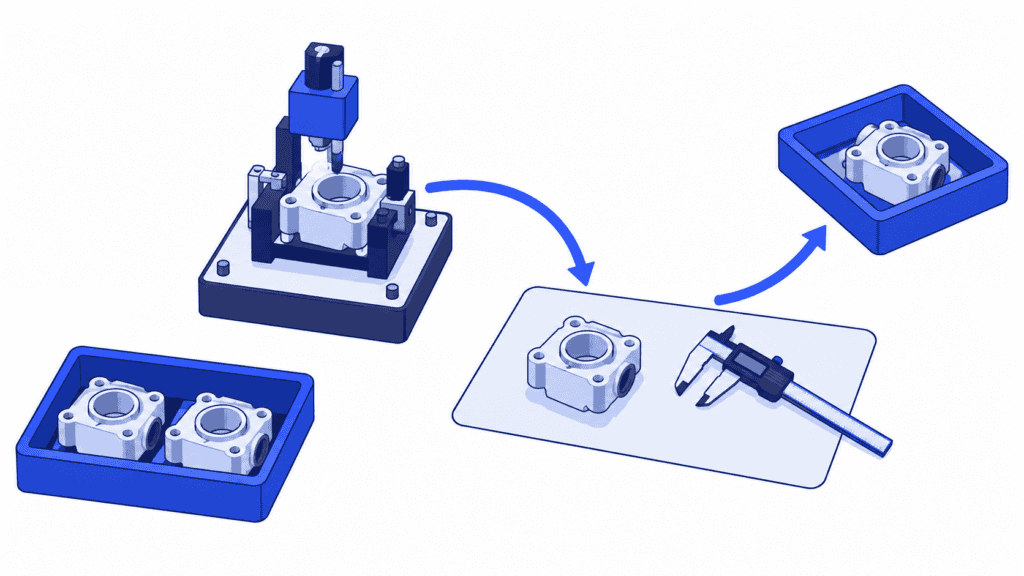
Imagine an operator loading a housing into an automatic fixture, waiting for machining to finish, then unloading and inspecting it. Across shifts, some operators inspect immediately; others accumulate parts and inspect a tray later. Output looks different, and defects can remain undetected longer.
The team trials a defined sequence: unload the completed housing, load the next one, start the automatic cycle, then inspect the previous housing at a dedicated position. A clear identification method keeps the inspected and unchecked parts separate. The trial confirms whether inspection can finish before the operator must return and defines where each part belongs at the repeat point.
This is more than changing the words in an instruction. The operator’s work overlaps the automatic cycle, but that does not mean the machine’s processing duration becomes shorter. The accepted method must describe the overlap, the required stock positions and the inspection response. Planning must reflect the actual resource occupancy, not subtract all apparent operator waiting from the machine duration.
Release the method and planning changes together
Once the trial succeeds, make the accepted method available at the point of use and train the affected operators. Ask them to demonstrate the sequence and the important quality and safety points. A read-and-sign exercise alone does not show that the method is understood.
Give the standard an owner, a revision and an effective date. State which products, tooling and conditions it covers. Keep the previous version so a later review can distinguish a method change from a change in how the work was recorded.
Before the effective date, coordinate the related updates:
- The workstation’s method chart and supporting work instructions.
- The applicable route, eligible resources and operation dependencies.
- Validated processing, setup and other planning durations.
- Material presentation and replenishment responsibilities.
- Training and the treatment of orders already in progress.
Not every method change affects every item. A better hand position may leave the route and duration unchanged; a new fixture or inspection stage may change both. Decide the scope deliberately. Otherwise the floor follows the new method while the schedule continues reserving capacity for the old one.
Review deviations before rewriting the standard
Keep observing the method after release and give operators a straightforward way to raise problems or propose improvements. A recurring difference is a reason to investigate, not immediate proof that someone is working incorrectly.
When actual work does not match the standard, first ask whether the comparison is valid. Was it the same product variant and method revision? Were setup and waiting recorded in the same way? Was the required material available?
Then choose the response that fits the evidence:
- The accepted method cannot reliably produce the required quality or pace. Revisit its design and trial the change.
- The method works, but missing parts or equipment faults interrupt it. Address those conditions rather than hiding them inside a longer method time.
- A trained operator has found a better way. Evaluate it with the team, validate it and release the improvement for everyone.
- The method is unchanged, but comparable durations repeatedly differ from planning. Review the time basis and resource-loading assumptions, then correct the relevant inputs.
Changes in product design, tooling, layout, demand rhythm or inspection requirements should also trigger a review. Keep the standard as the current agreed method, not a permanent rule that blocks better work.
Put the accepted method to work across production with SkyPlanner
A local method improvement changes the space an order needs in the factory. Its route may now use a different resource, a shorter setup or an additional inspection stage. Those changes affect other orders sharing the same capacity.
SkyPlanner APS turns those accepted production inputs into one coordinated schedule. You define process-step durations, eligible workstations and dependencies, along with setup and teardown times. Arcturus, SkyPlanner’s scheduling AI, calculates the schedule against your configured capacity, shifts, operators and priorities. Material-aware scheduling brings material availability into that calculation, and the Gantt view shows the resulting plan.
That means less manual reconciliation between separate station lists when a method changes. You can see how the revised work fits with other commitments instead of improving one workstation’s plan while leaving downstream queues to catch up. You steer priorities and protect decisions with scheduling rules and locks.
SkyPlanner also connects the plan with production evidence. Time logs and job reports show recorded work, while its predicted-versus-realized report lets you compare planned durations with actual production times. Where historical order data is available, the process-step time graph provides a history-based duration estimate. Use that evidence to find inputs worth reviewing and check them against the method actually used.
UTU’s SkyPlanner review illustrates why a common schedule matters. The switchboard manufacturer previously planned through department-specific Excel sheets, and sequence changes in its ERP did not always reach the shop floor. With SkyPlanner connected to Oracle NetSuite, the Ulvila factory brought its lines and departments into one planning system. UTU reports that an updated work queue reaches the line in seconds. A change is useful when the people doing the work receive it.
Choose SkyPlanner when your agreed methods need to become a production plan the whole factory can follow. It integrates with any ERP or MES through its open REST API, helping you retain existing systems while bringing accepted routes, realistic durations and shared resources into coordinated scheduling.
Book a SkyPlanner demo with one approved method, its current route and a resource that other orders also use. See how a method change affects the shared plan and how actual durations can guide the next review. If you prefer to explore first, try SkyPlanner with demo data.
Jussi Mäntylä
Production Planning Specialist, SkyPlanner


