





In this article
- How the drum, buffer and rope work together
- The drum: give the constraint a workable schedule
- The buffer: protect the planned arrival
- The rope: hold back work that is not needed yet
- A drum buffer rope example: should this order start at 09:00?
- Manage the buffer by watching the work that has not arrived
- When the constraint changes with the order mix
- Use SkyPlanner to keep the release decision tied to a feasible plan
- What Piristeel changed beyond keeping departments busy
- Make the next release a decision, not a habit
Home » Resources » Drum Buffer Rope: When to Release Work to Production
Estimated reading time: 9 minutes
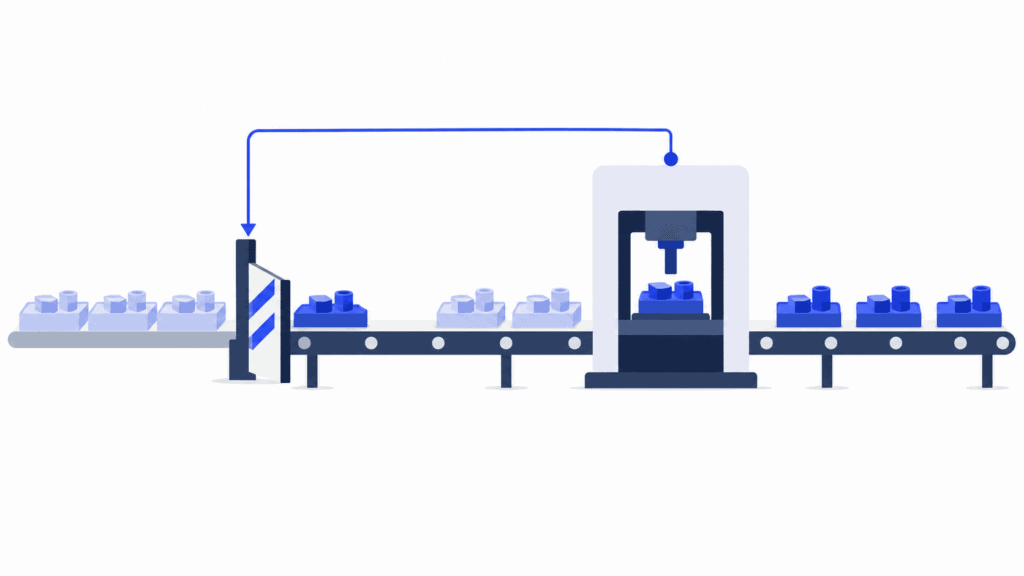
Drum buffer rope (DBR) is a production scheduling and control method that links the release of new work to the capacity of the operation limiting output. The drum sets the pace, the buffer protects it from disruption, and the rope controls when upstream work enters production.
It answers a question that a busy factory can easily overlook: does this job need to start now?
Starting more work does not create more capacity at the constraint. It can leave you with fuller queues, more material tied up in unfinished orders and more searching for the job that should run next. DBR makes timely completion the objective, rather than keeping every machine occupied.
For the planner, the challenge is maintaining that coordination as orders and capacity change. SkyPlanner APS calculates the connected production schedule, so your release decisions can follow available capacity and delivery priorities instead of a collection of manually maintained queues.
How the drum, buffer and rope work together
DBR comes from Eliyahu Goldratt’s Theory of Constraints. Its starting point is that improving an individual operation is not enough: production must flow through the resource that limits the output you need.
The drum: give the constraint a workable schedule
The drum is the constraint’s schedule: which work it will process, in what sequence and when. A heat-treatment furnace, specialist machine or scarce production team might set that pace.
Build its sequence around the orders you need to deliver, allowing for usable working time, processing and setups. Scheduling more hours than the resource has only conceals a shortage. A constraint schedule also needs to leave enough time after that operation for the remaining work and dispatch.
Upstream operations then serve that sequence. Their purpose is to make the right work ready for the constraint, not to produce as much as possible regardless of what happens next.
The buffer: protect the planned arrival
The constraint buffer provides time protection against upstream variation. Work is released early enough to reach the constraint before its scheduled slot, giving a late operation or transfer some room to recover.
That protection is not an instruction to build an unlimited pile of parts. A full queue can contain the wrong orders while the job needed next is still missing. What matters is whether the work required by the constraint schedule will arrive in time.
A shipping buffer protects a different point: completion before the customer delivery commitment. Keeping those purposes separate helps you see whether a delay threatens the constraint’s next slot or the final shipment.
The rope: hold back work that is not needed yet
The rope connects the constraint schedule to the release of upstream work. It tells production when to start feeding an order into the route, allowing for the time needed to reach the constraint and the protection you have chosen.
If an order is not needed yet, it stays unreleased even if an upstream machine has room. That is deliberate control of work in progress, not a failure to keep people busy. The available time can support preparation, maintenance or other useful work without adding another unnecessary batch to the queue.
The three parts depend on one another. A drum without protection can be starved. A buffer without controlled release can become excess inventory. A release rule tied to an impossible drum schedule merely sends the problem upstream.
A drum buffer rope example: should this order start at 09:00?
Imagine a shop where a specialist finishing station is the constraint. An order has a reserved finishing slot at 14:00. Its upstream processing and transfer take three hours, and the planner allows two additional working hours of protection. All the work in this example falls within one staffed day, with no breaks or other resource conflicts.
| Planning point | Time |
|---|---|
| Release upstream work | 09:00 |
| Expected arrival after three hours | 12:00 |
| Protected finishing slot | 14:00 |
Releasing at 09:00 gives the order five hours to reach its slot: three for the expected work and two for uncertainty. Those two hours protect the finishing slot; they are not extra processing time.
If an upstream delay adds one hour, the order arrives at 13:00. The constraint can still begin at 14:00. The buffer has done its job without requiring the finishing schedule to change.
Now imagine another order that does not need the finishing station until next week. Starting it this morning might improve an upstream machine’s utilization, but it does not help today’s finishing output. It adds material handling and a queue that today’s order must move through or be found among. The rope keeps that later work out until it is needed.
The release decision is therefore not “is the first machine free?” It is “when must this order enter production to protect its planned constraint slot?”
In a real shop, calculate that timing through the actual working calendars. Five working hours may cross a shift boundary, and two orders cannot both use the same upstream capacity at once. The example explains the release logic; a finite schedule establishes where the work actually fits.
Manage the buffer by watching the work that has not arrived
Once release is controlled, the daily task becomes more focused. Compare the jobs required by the drum with their progress upstream. Which are ready? Which are consuming their protection? Which now threaten a constraint slot?
If a job is still on schedule to arrive within its protection, it does not automatically need expediting. If its remaining work makes the planned arrival doubtful, investigate the cause and help that specific job through. Releasing more unrelated orders will not recover its missing material or complete its preceding operation.
Size protection from the variability you observe in the route. Too little leaves the constraint exposed to routine delays. Too much brings work into production unnecessarily early. There is no universal number of buffer days that suits every factory.
Record the causes of repeated buffer consumption. A recurring missing component, long transfer or unreliable process deserves a corrective action, not just a permanently larger allowance. Watch completed orders, delivery performance and work in progress together: a shorter queue is useful only if production still delivers the required work.
When the constraint changes with the order mix
The method is easiest to understand when a recurring constraint governs a substantial share of production. If the limiting resource changes with the order mix, a sequence built around last month’s bottleneck can mislead today’s release decisions.
You still need the discipline of limiting early work and protecting delivery-critical operations. But you also need to check the other resources, routes and dependencies. That is where finite-capacity scheduling becomes especially valuable: it connects the release discussion with a plan for the whole route, rather than assuming every non-constraint resource will always have room.
DBR is also not simply another name for Kanban or MRP. Kanban authorizes replenishment through signals and limits; MRP calculates material requirements from demand, product structures and inventory. DBR organizes release around the constraint and its protection. These approaches can work together, but a material requirement alone does not prove that an order should enter the floor today.
Use SkyPlanner to keep the release decision tied to a feasible plan
DBR gives you a way to think about flow. SkyPlanner APS handles the detailed scheduling work that keeps machines, order routes and delivery priorities connected.
You define workstations, shifts, operators, process steps and durations. Arcturus, SkyPlanner’s scheduling AI, places the work against the configured capacity and dependencies. The Gantt view shows the resulting workstation queues and connected operations. Instead of rebuilding each queue separately, you can see how the order reaches its critical operation and when the remaining work is scheduled to finish.
For a planner applying DBR principles, that changes the daily work in three important ways:
- Give scarce time to the right commitments. Set delivery and order priorities so the scheduling calculation reflects the work that matters, rather than treating every early start as a success.
- Check readiness along the route. With material-aware scheduling enabled, Arcturus considers inventory and incoming material availability as well as the production constraints. A planned machine slot is more useful when the material needed to use it is part of the calculation.
- Recalculate when the plan changes. Update capacity, progress or priorities and let Arcturus calculate the affected schedule. With Autopilot enabled, configured events or a timer can trigger rescheduling while your rules and locks remain in force.
SkyPlanner also provides a start eligibility date: the earliest date an order may start in the schedule. That can represent a decision to hold work back. Its Buffer days setting serves a different purpose, providing a completion cushion before delivery that influences scheduling priorities.
An earliest scheduling date is not the same as physically releasing an order to the shop floor, and a delivery cushion is not the same as a DBR constraint buffer. If you require an automated DBR release workflow, make the release trigger and responsibility part of your SkyPlanner demonstration. The immediate reason to choose SkyPlanner is clear: it calculates and maintains the capacity-based production plan behind those decisions, saving you the manual work of coordinating every queue.
What Piristeel changed beyond keeping departments busy
Piristeel, a manufacturer of roof safety products and rainwater systems, previously ran large batches and maintained substantial buffer stocks. Production appeared to run smoothly, but inventory was high and changes were cumbersome. Departments lacked a shared picture of what the others were doing, while maintaining the schedule across three departments occupied one person’s full working time.
With SkyPlanner, automated detailed scheduling and a shared Gantt view brought visibility across those departments. Piristeel reports better coordination of smaller production runs and improved responsiveness to customer orders. Large buffer stocks were no longer a prerequisite for smooth operations.
The relevance to DBR is the distinction between having plenty of work and having coordinated flow. Piristeel’s experience shows why visible capacity and connected schedules are worth pursuing when inventory has been compensating for poor coordination.
Make the next release a decision, not a habit
Before releasing another order, check the slot it needs at the limiting resource, the time required to reach it and the protection justified by the route. Then follow the work through to the delivery commitment. That is the practical value of drum buffer rope: start work because the system needs it, not merely because one machine is free.
Choose SkyPlanner APS when maintaining that connected plan is consuming your planners’ day. SkyPlanner integrates with any ERP or MES through its open REST API, so you can connect existing order data with capacity-based scheduling without replacing a system that already serves you well.
Book a SkyPlanner demo with a typical order route, its constraint and a recent early-release or expediting problem. Use those to see how the schedule would support your next release decision. Or try SkyPlanner with demo data to explore the scheduling view first.
Jussi Mäntylä
Production Planning Specialist, SkyPlanner


