








In this article
- When should you use 8D?
- The eight disciplines: what each stage must accomplish
- D1: Establish a team that can investigate and act
- D2: Describe the problem without deciding its cause
- D3: Contain the problem and verify the protection
- D4: Verify why the defect occurred and why it escaped
- D5: Choose and verify permanent corrective actions
- D6: Implement the actions and validate effectiveness
- D7: Prevent recurrence beyond the original incident
- D8: Close the work and recognize the team
- What belongs in a customer-ready 8D report?
- Give corrective work real capacity with SkyPlanner
Home » Resources » 8D Problem Solving: From Complaint to Proven Correction
Estimated reading time: 11 minutes
The customer wants an 8D response. Your team has sorted the suspect stock, repaired the returned parts and assigned someone to update the report. But the next production batch will use the same process. What will stop the problem from coming back?
8D problem solving is a team-based method for resolving a problem through eight disciplines: establish the team, describe the problem, contain it, verify its causes, select permanent corrective actions, implement and validate them, prevent recurrence, and recognize the team. The 8D report records that work; filling it in is not the same as completing it.
For a manufacturer, a credible response connects customer protection with evidence that the correction works. It also needs real production time. SkyPlanner APS helps you fit approved inspection, rework and trial-production operations into the same schedule as customer orders, so the corrective action plan does not become a separate queue that production cannot deliver.
When should you use 8D?
Use 8D when a significant or recurring problem needs coordinated investigation and a permanent correction, especially when a customer requests a structured response. It is particularly useful when the cause is not yet established and several functions must contribute to the solution.
Not every isolated issue needs a full 8D investigation. Follow your quality process and the customer’s requirements when deciding the scope. A known, straightforward correction may need a simpler response; an unresolved customer failure should not be reduced to one just to close the paperwork.
Some organizations add D0, a preparation stage that establishes urgency, immediate response and the resources needed for the investigation. Do not wait for a formal team meeting to protect the customer if suspect product is still moving.
8D provides the overall framework. Root cause analysis belongs within it, mainly in D4. Five whys and fishbone diagrams help investigate causes; they do not replace containment, implementation or proof of effectiveness. An A3 can communicate a broader improvement story, while an 8D response follows the disciplines required for this problem and its customer-facing resolution.
The eight disciplines: what each stage must accomplish
The disciplines build on one another, but the work is not always a neat sequence of meetings. Containment may start immediately, and new evidence may send the team back to its problem definition or cause analysis. Keep the report current as the investigation develops.
D1: Establish a team that can investigate and act
Choose people who understand the product, the process and the failure, with authority and time to implement changes. A typical manufacturing team needs quality, production and process or engineering knowledge. Include logistics, maintenance, purchasing or the supplier when their work is relevant.
Name a leader, a customer contact and owners for the immediate actions. Make the production planner part of the discussion when inspections, repairs or trials will compete with normal orders. Otherwise, an action can have an owner and a due date without anyone having secured the time to do it.
D2: Describe the problem without deciding its cause
State the requirement, the observed deviation and the affected population. Record the product and revision, lot or serial identifiers, where and when the issue appeared, quantities and the evidence available. Use measurements, photographs or test results rather than “poor quality” or “assembly problem.”
Also record where the problem does not occur. An affected batch compared with an unaffected batch can reveal a useful difference in tooling, material, settings or operating conditions.
Keep observations separate from explanations. “The terminal pulls out during the customer’s retention test” describes a failure. “The operator did not insert it properly” is a proposed cause that still needs evidence. If the affected scope remains uncertain, say what is known and how you will investigate the rest.
D3: Contain the problem and verify the protection
Containment temporarily protects the customer while the team works toward a permanent solution. Depending on the risk, it may involve stopping shipment, identifying and segregating suspect stock, screening parts or arranging controlled replacement deliveries.
Trace the suspect population through the locations it can occupy: work in process, finished stock, external processing, transit and the customer’s site. Coordinate the response with the customer rather than assuming an internal stock check covers the exposure.
For each containment action, record its scope, owner, implementation time and results. Check that the screening method can detect the reported defect. A completed inspection is weak protection if the method cannot distinguish a bad part from a good one.
Containment, correction and corrective action serve different purposes. Holding suspect units protects the customer. Repairing an affected unit corrects that unit. Changing the verified cause prevents recurrence. A successful repair does not, by itself, establish that the production process is fixed.
D4: Verify why the defect occurred and why it escaped
Investigate two connected questions:
- Occurrence: What caused the nonconformity to be created?
- Escape: Why did the controls fail to prevent it from reaching the customer?
Identify the escape point: the place in the process where the problem should have been detected but was not. Then investigate why that control failed. The absence of an effective check and a check that was not followed are different problems and may need different changes.
Use the process history, comparisons and appropriate analysis tools to develop hypotheses. Test those hypotheses against the evidence. A plausible five-whys chain is still a theory until the team demonstrates that it explains the failure and the observed boundaries of the problem.
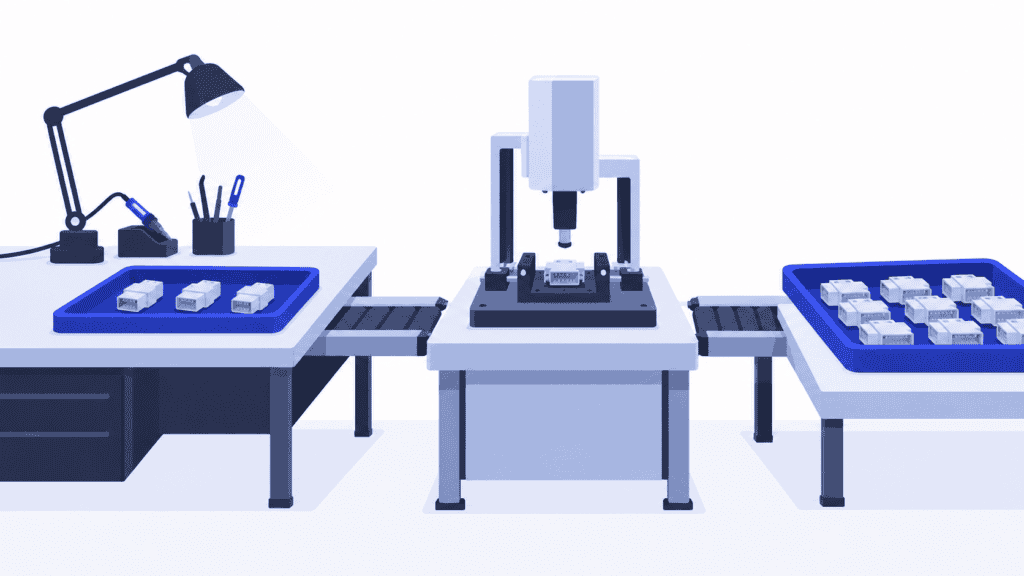
Imagine an electrical connector with a terminal that makes contact but is not fully retained. An insertion fixture might permit incomplete engagement, while a continuity test still passes because it does not assess retention. These are separate occurrence and escape hypotheses. The team must investigate the fixture and the test under controlled, safe conditions; simply adding another continuity check would not answer the retention problem.
“Human error” is not a useful stopping point. Ask what made the error possible, why the process failed to prevent or detect it, and which evidence supports that explanation.
D5: Choose and verify permanent corrective actions
Select actions that address the verified causes, including the escape cause. Compare alternatives for effectiveness, feasibility and unintended consequences rather than choosing the easiest action to write into the report.
Define the acceptance criteria before the trial. What result would show that the proposed change works? Which operating conditions must the test cover? How will you know that the change has not introduced a different defect or an unacceptable process burden?
In the connector illustration, a proposed fixture change would need to demonstrate reliable engagement. A proposed detection change would need to distinguish the relevant unacceptable condition. Neither claim follows merely from buying the equipment or revising an instruction.
This is the role of D5 verification: establish that the selected action is capable of solving the problem before relying on it as the permanent production solution.
D6: Implement the actions and validate effectiveness
Put the verified changes into the actual production process. That may require tooling changes, revised process settings, approved instructions, updated inspection methods and training. Record when and where each change took effect so the team can distinguish production before and after implementation.
Then validate the result in use. Compare the evidence with the agreed acceptance criteria over a period and production scope appropriate to the risk. Define the lots, quantities, shifts or operating conditions covered, and assess the specific defect rather than relying only on an overall scrap figure.
An installed change is evidence of implementation. Measured performance after the change is evidence of effectiveness. One is not a substitute for the other.
Keep interim protection in place until the evidence supports removing it and the relevant release requirements are met. Where the customer requires approval, obtain it. If validation fails, investigate the result and revisit the cause or the corrective action; do not relabel an unsuccessful trial as closure.
D7: Prevent recurrence beyond the original incident
Make the successful correction part of the normal system. Update the relevant work instructions, control plans, process risk analysis, training and change-control practices. Review similar products, machines and sites to decide where the same failure mechanism could exist.
The aim is not to copy every action everywhere. It is to find where the same causal conditions apply and make an appropriate change. Assign ownership for maintaining the new controls so the improvement survives the next tool replacement, product change or shift handover.
D8: Close the work and recognize the team
Review the result, share the learning and recognize the people who contributed. Close the report through the required internal and customer process, with the supporting evidence accessible to the reviewer.
Recognition matters because the solution often depends on people who found a difficult truth, challenged an assumption or made time for a trial. Preserve that learning, not just the final signature.
What belongs in a customer-ready 8D report?
Use the customer’s form or portal when one is specified. A clear report should let someone outside the investigation follow the connection from the complaint to the verified causes and the results of the correction.
Before sending an update, check that it contains:
- A clear problem statement and the affected product or lot scope, including unresolved boundaries.
- Containment actions and evidence that they protect the customer.
- Verified occurrence and escape causes, with the supporting investigation.
- Corrective actions linked to those causes, with owners and target dates.
- D5 verification and D6 implementation and effectiveness evidence, clearly distinguished.
- Recurrence-prevention changes and the status of containment removal and closure.
Attach or reference the measurements, trial results and controlled documents that support the conclusions. Keep planned actions visibly separate from completed actions. If a cause remains unverified, give the next investigation step rather than presenting a guess as fact.
There is no single response deadline that applies to every 8D. Confirm the customer’s required acknowledgement, containment update, interim response and final submission dates at the start. If effectiveness monitoring will take longer than the reporting deadline, agree the next update and the evidence still outstanding. A prompt, honest interim response is more useful than an unsupported declaration that the problem is solved.
Give corrective work real capacity with SkyPlanner
The investigation can reach the right answer and still stall at implementation. The inspector is already covering dispatch, the repair bench has a backlog, and the trial needs the same test station as tomorrow’s customer order. An 8D action list does not resolve those conflicts.
SkyPlanner APS brings the approved production work into one executable plan. Represent the inspection, repair, trial and retest as operations with realistic durations, eligible workstations and dependencies. Add the relevant production notes and attachments to the order, order item or process step so the people doing the work have the instructions at hand.
Arcturus, SkyPlanner’s scheduling AI, places the operations against configured workstation capacity, shifts, eligibility dates, dependencies and priorities. With material-aware scheduling enabled, it also considers material availability. The Gantt view shows how corrective work fits alongside normal production and what the resulting schedule means for completion dates.
That reduces the manual work of reconciling separate quality and production queues. You can see the competition for the test station, decide which work takes priority and communicate the delivery consequences before making another promise. SkyPlanner integrates with any ERP or MES through its open REST API, connecting existing production data with that shared schedule.
You can also work through your own AI assistant, such as Claude, ChatGPT or Microsoft Copilot, connected to SkyPlanner through MCP. MCP is the connection that lets the assistant use SkyPlanner’s data, product knowledge and functions within its permissions. For example, ask it to review the test-station queue and help schedule an approved trial and retest around existing commitments. You explain the planning need; the assistant helps use SkyPlanner without making you navigate each function yourself.
The quality decision remains distinct from the scheduling decision. SkyPlanner’s time logs can show recorded work, completed and faulty quantities, times and notes. Those records help establish what was done; they do not by themselves prove the cause, validate the correction or authorize customer release.
For a manufacturing team managing 8D work alongside live orders, choose SkyPlanner to make the approved corrective workload part of the production plan, not an afterthought. Book a SkyPlanner demo with one approved inspection or correction route, its trial and retest requirements, and the customer work competing for the same resources. You will have a concrete basis for discussing how the work can fit and which commitments need attention. To explore the scheduling first, try SkyPlanner with demo data or the AI-assisted Getting Started in SkyPlanner Assistant.
Jussi Mäntylä
Production Planning Specialist, SkyPlanner


