








In this article
- How mass production works
- Mass production vs. batch and job production
- The advantages of mass production
- Lower production effort and cost per unit
- More consistent work and easier quality control
- Capacity that can meet substantial demand
- The risks that can erase the savings
- Demand falls short of the production commitment
- Product changes become more expensive
- Disruption affects more output
- How to decide whether mass production suits your product
- Keep high-volume work and shared capacity in one SkyPlanner schedule
- Piristeel: beyond large runs and buffer stock
- Make scale work for your delivery promises
Home » Resources » Mass Production: Benefits, Risks and When It Pays
Estimated reading time: 11 minutes
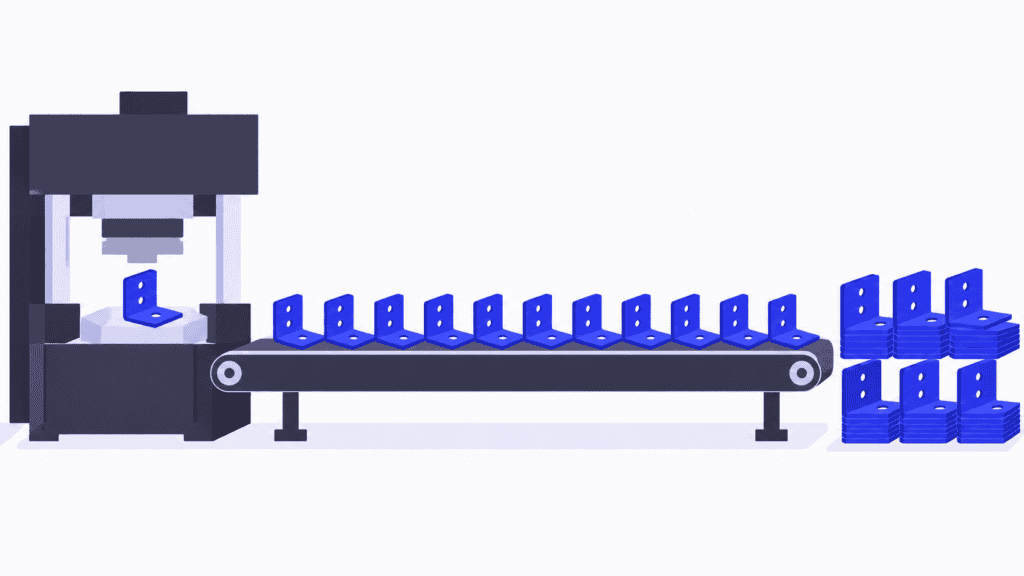
Mass production means manufacturing standardized products in large quantities through an organized, repeatable process. It often uses specialized equipment, dedicated production lines and a division of work that makes each unit faster and less expensive to produce.
The attraction is clear: spread preparation and investment across more output, make work more consistent and meet substantial demand. The difficult part is ensuring that the volume earns its keep. A fast machine does not help profitability if its output sits unsold, waits for finishing or becomes obsolete after a design change.
For a manufacturer considering mass production, the useful question is not just “Can we make more?” It is “Can we sell and deliver enough of this standardized product to justify the commitment?” SkyPlanner APS helps with the delivery side of that decision by bringing volume work, other orders and the resources they share into one production schedule.
How mass production works
Mass production removes the need to solve the manufacturing method again for every unit. The product has an established design, components and specifications. Its operations follow a defined sequence, with repeatable methods, appropriate tooling and checks at the points where quality matters.
Instead of asking each worker to build the whole product from beginning to end, work is divided among stations, machines or teams. Specialized fixtures and equipment reduce handling and processing effort. Automation can take on repeated operations, but mass production does not require every task to be automated or every product to travel on a conveyor.
The flow must also work as a whole. Material supply has to support the intended output; later operations need room for what earlier operations produce. Inspection, packing and dispatch are part of the delivery capacity, not details to resolve after increasing the main line’s speed.
Familiar examples include standard fasteners, molded plastic closures, electrical components and consumer appliances. They differ in complexity and equipment, but share the same economic idea: repeat enough standardized work to make an efficient production arrangement worthwhile.
There is no universal number of units that makes production “mass production.” A suitable volume depends on the product, equipment, preparation cost and demand over its useful life. Nor must the factory run around the clock. High-volume production can operate within scheduled shifts and stop for maintenance or changes.
Mass production vs. batch and job production
The choice involves a trade-off between efficiency at scale and the freedom to make something different. Compare the product’s likely demand and variation, rather than choosing a label for the entire factory.
| Decision | Mass production | Batch production | Job production |
|---|---|---|---|
| What is organized? | High volumes of a standardized product or controlled range | A defined quantity before a switch to another product or variant | An individual job, often with customer-specific requirements |
| Where does efficiency come from? | Reusing specialized resources and a stable flow across substantial output | Sharing setup effort across a run while reusing equipment for other runs | Matching methods and resources to the particular job |
| What demand pattern helps? | Enough sustained demand to justify the production commitment | Repeated or intermittent demand for different quantities and variants | Orders whose individual requirements justify tailored work |
| What flexibility is traded away? | Dedicated tooling and arrangements can make significant changes expensive | Changeovers consume capacity and other batches wait their turn | More preparation and coordination may be needed for each job |
These are not sealed categories. A high-volume factory can manufacture variants in batches, and a job shop can make several identical parts together. A business might dedicate one line to a standard product while keeping other resources flexible for special orders.
Two related terms need care. Repetitive manufacturing describes recurring work through a stable process; it need not reach mass-production scale. Continuous production describes an ongoing process flow, such as a bulk refining process. A line assembling identifiable products at high volume can still stop between shifts or production runs.
Make to stock and make to order answer another question: what triggers production? A mass-produced product can replenish stock or fulfill substantial customer orders. High volume alone does not decide the inventory policy.
The advantages of mass production
Lower production effort and cost per unit
Standard tooling, established methods and repeated operations reduce the preparation and handling needed for each unit. Specialized equipment can perform familiar work efficiently, while fixed costs are spread over more output.
Those savings make a standard product more competitive when the business has enough demand to use the arrangement well. They can also create room for a better margin without raising the selling price. The saving is valuable because the method uses fewer resources per saleable unit, not because the factory produces the largest possible pile of stock.
More consistent work and easier quality control
Common specifications, fixtures and instructions make the expected result clearer. Operators can learn a stable method, and inspectors have a consistent basis for detecting a deviation. An improvement to a repeated operation benefits subsequent production rather than only one job.
Standardization supports quality; it does not guarantee it. The same repeatable process can reproduce a defect quickly if a tool wears, a setting is wrong or a component is unsuitable. Checks must detect problems before a long run turns them into a large loss.
Capacity that can meet substantial demand
An organized flow can produce more units in the available time than a method that repeatedly changes tools, routes or instructions. That helps a manufacturer supply customers at the quantities and pace they need.
The advantage depends on the slowest necessary stage. Increasing the press rate cannot increase finished deliveries when coating or packing is already full. Measure success in conforming products ready for customers, not just units leaving the fastest operation.
The risks that can erase the savings
Demand falls short of the production commitment
Dedicated equipment, tooling and space cost money even when the expected sales do not arrive. A long run may reduce the apparent cost of each unit while tying up cash in products that will not sell soon enough.
Imagine a production line with $60,000 in fixed costs per month. At 20,000 saleable units, that is $3 of fixed cost per unit. At 10,000, it is $6. Material, labor, energy, scrap and other costs still have to be covered; this is only the fixed-cost allocation, not the full unit cost or profit.
Producing the missing 10,000 units for stock does not solve a demand shortage. It adds inventory exposure. Test the proposed arrangement against credible lower-demand scenarios as well as the headline forecast.
Product changes become more expensive
A change that is easy on flexible equipment may require new tooling, revised automation, qualification or substantial downtime on a dedicated line. Old components and finished stock may also need rework or become unusable.
Controlled variants can work well in mass production, especially where they share a common platform. The important question is what each difference changes in production. A color option, an extra operation and a redesigned core component do not have the same cost or capacity effect.
Disruption affects more output
A material shortage or an unavailable shared resource can interrupt a high-volume flow. Producing faster upstream may simply create more work in progress in front of the interruption. Large buffers can conceal the imbalance without fixing it.
Likewise, a long run can occupy capacity that another customer needs sooner. Setup efficiency matters, but it must be balanced against delivery commitments. A cheap run that makes a more valuable order late may be the wrong choice for the business.
Repetitive tasks also deserve attention to ergonomics, safe work design, training and job organization. An efficient process must be sustainable for the people doing it, not only attractive on a machine-rate calculation.
How to decide whether mass production suits your product
Start with one product or a tightly defined range. You do not need to reorganize every order around the same method.
Check whether demand can sustain the commitment. Examine order history, customer commitments, seasonality and the expected product life. Separate a lasting requirement from one unusually large order. Ask what happens if demand arrives later, changes mix or falls below the forecast.
Decide how much of the product can stay standard. Identify the approved design, common components and allowed options. Price the production consequences of likely changes, including tooling, instructions, inspection and existing stock. If every order needs substantial new engineering, a more flexible arrangement may be worth its higher unit effort.
Verify capacity through the complete route. Use credible processing and setup times, scheduled working hours and the other work already using each resource. Include material preparation, finishing, testing and packing. A supplier’s nominal machine rate is not proof that your factory can deliver at that rate.
Compare the alternatives on the same basis. Include equipment and tooling, operating costs, expected rejects, changeovers, maintenance and inventory exposure. Compare realistic saleable quantities over a consistent period. A flexible batch process may cost more per unit yet be the better business choice when demand or designs change frequently.
Prove the assumptions before committing to the full volume. Use a controlled run to check actual cycle times, quality, material consumption and downstream flow. Resolve recurring losses before multiplying them. The evidence should support the investment and operating decision, not merely demonstrate that a machine can run fast for a short test.
Mass production is most attractive when sustained demand, a stable design and supportable capacity come together. Where only the volume is convincing, investigate the missing conditions before dedicating more resources.
Keep high-volume work and shared capacity in one SkyPlanner schedule
Imagine a manufacturer expanding output of a standard metal bracket. Its dedicated press has enough time, but the brackets share finishing and packing with other products. A large standard run looks efficient in the press plan; the finishing department already has customer orders due earlier.
The decision is not simply to make the press run longer. The planner needs to see which quantities can move through finishing and packing in time, what material is available and which deliveries need priority. Separate departmental lists make that reconciliation a daily burden.
SkyPlanner brings the defined jobs, workstations, shifts, operators and priorities into a common plan. Its scheduling AI, Arcturus, calculates the sequence against configured capacity and operation dependencies. With material-aware scheduling enabled, recorded material availability also affects the calculation. The Gantt timeline shows where the work is scheduled and when it is expected to finish.
For the bracket manufacturer, the volume run no longer occupies an imaginary finishing slot that another order also needs. Its work is scheduled alongside those commitments. When a material date or capacity changes, Arcturus can recalculate the plan without leaving the planner to rebuild every resource queue by hand.
You can also use product properties and workstation rules to group similar jobs, such as the same color, consecutively. That helps preserve useful setup efficiencies while delivery priorities and protected decisions remain part of the plan. Planners decide the rules and priorities; Arcturus handles the scheduling calculation.
This is the reason to choose SkyPlanner for discrete volume production: less manual coordination between queues and a clearer view of what the factory can deliver. SkyPlanner integrates with any ERP or MES through its open REST API, so that schedule can build on the order and production systems you already use.
Piristeel: beyond large runs and buffer stock
Piristeel, a Finnish manufacturer of roof safety products and rainwater systems, illustrates why efficient-looking runs are not the whole answer. Its customer story describes large batches and substantial buffer stocks alongside spreadsheets, printed work orders and poor visibility between three production departments. Changing the plan was cumbersome.
During a phased implementation with Visma Nova, Piristeel brought detailed scheduling into SkyPlanner. Its Gantt timeline gave planners a shared view of departmental load and expected completion. The company reports better coordination of smaller runs and greater responsiveness to customer orders, as well as up to four hours of scheduling time saved per day.
The lesson is not that every manufacturer should make smaller runs. It is that production quantities need to serve the delivery plan. Better visibility lets efficient standard work coexist with the changes customers actually need. Read Piristeel’s SkyPlanner review for the full customer experience.
Make scale work for your delivery promises
Mass production pays when standardization reduces the effort of making enough products that customers will buy. Protect that advantage by checking demand, the cost of change and capacity beyond the main line. More output is useful only when the business can turn it into worthwhile deliveries.
Choose SkyPlanner when coordinating that flow across shared resources is taking too much planning time. Bring a standard product family, its material requirements and a shared finishing, testing or packing resource to a SkyPlanner demo. Include another order competing for that resource: it is a practical way to see how one schedule can support both volume efficiency and customer commitments.
Book a SkyPlanner demo to explore your production. If you prefer to look around first, try SkyPlanner with demo data.
Jussi Mäntylä
Production Planning Specialist, SkyPlanner


